The best idea management solutions match the source of your ideas. If customers send the ideas, pick a feedback portal with voting and a public roadmap, such as Koala Feedback or Aha! Ideas. If employees send them and you need challenges, stage gates, and portfolio views, pick an enterprise innovation platform such as Brightidea, HYPE, Wazoku, ITONICS, or Qmarkets. Whichever you choose, it should tell every submitter what happened to their idea.
Most teams start with a spreadsheet, a Slack channel, and a shared inbox. That works until a second team joins, duplicates pile up, and people ask why nobody answered their suggestion. The real cost is the good ideas that quietly die and the contributors who stop sharing.
This article compares seven platforms on the same terms: what each does, who it suits, what it costs, and where it falls short. We build Koala Feedback, so it comes first, and we say plainly where it is the wrong fit. Enterprise vendors mostly quote prices on request, so treat their entries as a map for your demo calls.
Idea management solutions collect ideas in one place, let people discuss and vote on them, score them against shared criteria, and report the decision back to the contributor. The biggest difference between products is the audience: some are built for customers, others for employees.
An idea tool is only as good as the answer it gives the person who submitted the idea.
An idea portal is the page where people submit ideas, browse what others posted, vote, and comment. Behind it, the software runs three jobs. Idea management ends once an idea is selected, while innovation management continues into testing, project planning, and delivery. Some enterprise platforms cover both.
Customer feedback portals and internal innovation platforms solve different problems, so compare like with like. Feedback portals are light and public. Innovation platforms are configurable and process-heavy.
| Customer feedback portals | Internal innovation platforms | |
|---|---|---|
| Ideas come from | Customers and users | Employees, partners, sometimes outside solvers |
| Typical owner | Product manager | Innovation or R&D lead |
| Core workflow | Submit, vote, prioritize, publish a roadmap | Challenges, scoring criteria, stage gates, portfolio |
| Buying process | Often a free plan or trial | Demo, scoping call, custom quote |
| In this list | Koala Feedback, Aha! Ideas | Brightidea, HYPE, Wazoku, ITONICS, Qmarkets |
Koala Feedback is the quickest of these idea management solutions to launch for customer ideas. It pairs a branded feedback portal with voting, prioritization boards, and a public roadmap, and a portal can be live in minutes.

Koala Feedback turns customer requests into a visible, ranked roadmap without an enterprise rollout.
Customers post ideas on your portal, then vote and comment on what others posted. Koala automatically deduplicates and categorizes incoming feedback, so ten people asking for the same export option land on one request instead of ten scattered posts. Prioritization boards then group requests by product area or feature set, which keeps triage manageable.
Product managers, SaaS business owners, and development teams get the most from it, especially when ideas come from users rather than staff. Because the portal is public, transparency becomes part of how you manage expectations.
Signing up is free, and the Starter plan costs nothing, so you can test the portal with real customers before paying. Growth removes the board and post limits. Business adds unlimited statuses. Paid plans are billed annually.
| Plan | Price | Boards | Statuses | Admins | Active posts |
|---|---|---|---|---|---|
| Starter | Free | 3 | 5 | 1 | 100 |
| Growth | $29/month | Unlimited | 6 | 5 | Unlimited |
| Business | $89/month | Unlimited | Unlimited | 5 | Unlimited |
The trade-off is focus. Koala handles collecting, prioritizing, and communicating customer feedback, not multi-stage evaluation of internal innovation projects. If your ideas need budget approvals and portfolio reporting, one of the enterprise platforms below fits better.
Aha! Ideas is the best fit among these idea management solutions for product teams that want an ideas portal wired directly into a roadmap. Customers and teammates submit and vote on ideas, and you promote the strongest ones into Aha! Roadmaps.
Aha! Ideas works best when the roadmap already lives in Aha!.
The tool gives customers and colleagues one customizable ideas portal for submitting feedback and tracking progress. An AI assistant helps you spot themes and duplicate requests across large volumes of input. Scoring then happens against criteria you define.
Product managers who review every idea and need a clean handoff from idea to feature backlog are the core audience. Marketing, support, and engineering colleagues can also feed ideas into the same portal.
Aha! offers a free trial, so you can test the portal before you commit. Prices are set by the vendor, so check its current pricing page for plan limits and per-user costs.
Ideas sits inside a wider product management suite, and many of its basic capabilities also appear in Aha! Roadmaps. If you do not need the rest of the suite, compare it against a standalone portal so you do not pay for tools your team will not open.
Brightidea suits organizations that run structured employee innovation programs, such as challenges and hackathons, and want to test ideas before building them. It also offers a 30-day free trial, which is rare among enterprise platforms.

Brightidea gives innovation teams a lab for validating ideas, at the cost of a learning curve.
The platform splits work into five modules, each covering one stage of an idea program. Managers can organize submissions by category and run challenges, hackathons, and internal shark tanks from the same system.
Corporate innovation managers who run campaigns across departments will use the full range. The trial and demo make it easier to judge fit before a purchase decision.
Brightidea does not list prices on its site. Third-party review sites have reported plans starting around $59 a month, but confirm that figure with the vendor, because enterprise needs usually change the quote.
Reviewers also mention a steep learning curve and say admins benefit from CSS and HTML knowledge during setup. Budget admin time and training before you launch to employees.
HYPE Innovation suits large enterprises that want software and consulting together, covering strategy, ideation, partnering, and project delivery. Consultants meet you before onboarding, learn your challenges, and shape the workflow around your strategy.
HYPE is a consultant-led platform, so it fits companies that want a partner, not just a login.
HYPE organizes its enterprise suite into four modules. The Ideation module lets managers build strategic campaigns, source ideas from other users, and evaluate submissions. The Projects module then manages the portfolio and brings approved ideas to life.
HYPE also sells Viima, a lighter idea platform for collecting ideas and feedback.
Global enterprises with dedicated innovation teams are the target, and the vendor lists customers such as Nokia and Ricoh. It also has specialized solutions for the legal sector.
Each product and the consulting services are sold separately. You request a demo, describe your needs, and receive a custom quote, so there is no public price to compare.
Consultant-led onboarding is a strength and a dependency. In the demo, ask how many workflows you can run in parallel and which changes your own admins can make without a services engagement.
Wazoku suits large organizations that want internal ideas and open innovation with outside solvers on one platform. It is an enterprise-grade product with a wide module set and readily available training.
Wazoku is the pick when your best ideas may come from outside your company.
Wazoku combines employee idea collection with external problem-solving. Teams can run challenges and reward contributors internally, then open selected problems to Wazoku Crowd, a public hub of innovators.
The platform also includes AI-assisted analysis, reporting, integrations, and enterprise security options.
Corporate innovation teams that tackle complex, cross-functional problems will use the breadth. Smaller teams may find the scope more than they need.
Wazoku does not publish pricing. You book a demo and receive a custom quote after the team scopes your use case.
Breadth brings heavier implementation. The Wazoku team builds workflows and adjusts the platform on request, so confirm during the demo how much your own admins can change without vendor help, and how long onboarding takes.
ITONICS suits R&D and strategy teams whose ideas compete with trends, technologies, and running projects for budget. It also documents its security controls in detail, which helps when IT joins the evaluation.

ITONICS fits when an idea has to be judged next to the projects it competes with.
ITONICS stores ideas as elements next to the trends, technologies, and projects they relate to. Its workflow builder configures phases and gates with criteria, assignees, notifications, and handovers. Teams then prioritize ideas in matrix and Kanban views.
Multi-unit enterprises that need one portfolio view across separate business units are the clearest match. R&D pipelines, where an approved idea becomes a funded project, also fit well.
ITONICS has an Enterprise tier and points buyers to a demo, so plan for a quote rather than a list price. Ask what is included at each tier before you compare costs.
A broad platform means more setup. The vendor's own buying guide suggests planning about 16 weeks from signature to go-live for an enterprise rollout, which is a useful reality check for every platform on this list.
Qmarkets suits organizations that want to configure their own idea workflows without coding and add trend research and scouting around idea collection. Its template library gives you a starting point, and you can build from scratch.
Qmarkets gives admins self-service control over how ideas move from submission to implementation.
Qmarkets sources ideas from employees, partners, customers, and other groups, then moves them through a pipeline. Its five offerings cover the path from idea intake to impact reporting.
Innovation teams with their own admins, who want to adjust stages without waiting for a vendor, will value the self-service setup. Teams that also track technologies and trends get the most from the extra modules.
Qmarkets does not publish pricing, so contact the team for a custom quote. Because the product is split into five offerings, ask exactly which ones your quote covers.
Before buying, check how much submitters can see and co-create at the idea stage. If open discussion drives participation in your culture, test that experience in the demo with real users.
Start with who submits ideas and what happens after approval. Those two answers eliminate most of this list within minutes, and the rest comes down to administration effort, security needs, and budget.
Decide the audience and the post-approval path first, and the shortlist builds itself.
| Tool | Best for | Ideas come from | Pricing |
|---|---|---|---|
| Koala Feedback | SaaS product teams | Customers | Free plan, paid from $29/month billed annually |
| Aha! Ideas | Teams planning in Aha! | Customers and teammates | Free trial, see vendor |
| Brightidea | Challenges and validation | Employees | 30-day trial, quote |
| HYPE Innovation | Consultant-led enterprise programs | Employees, partners | Custom quote |
| Wazoku | Open innovation | Employees and outside solvers | Custom quote |
| ITONICS | R&D pipelines, strict security | Employees, experts | Demo, quote |
| Qmarkets | Self-configured workflows | Employees, partners, customers | Custom quote |
Run these as pass or fail checks before you compare features and prices.
Judge answers by what the vendor shows live with your own sample ideas, not by slides. Names such as IdeaScale, Viima, Ideanote, and Planbox also appear on shortlists, and the same five questions apply to them.
Picture a 40-person SaaS company with four product areas, three people triaging requests, and about 300 active feedback posts. Koala's Starter plan fails on all three counts, since it allows 3 boards, 1 admin, and 100 active posts.
Growth fits at $29 a month, which is $348 a year billed annually, with unlimited boards, five admins, and unlimited posts. Business at $89 a month, or $1,068 a year, only pays off if you need more than six statuses. An enterprise platform would add a quote, a demo cycle, and weeks of onboarding for a problem this team does not have.
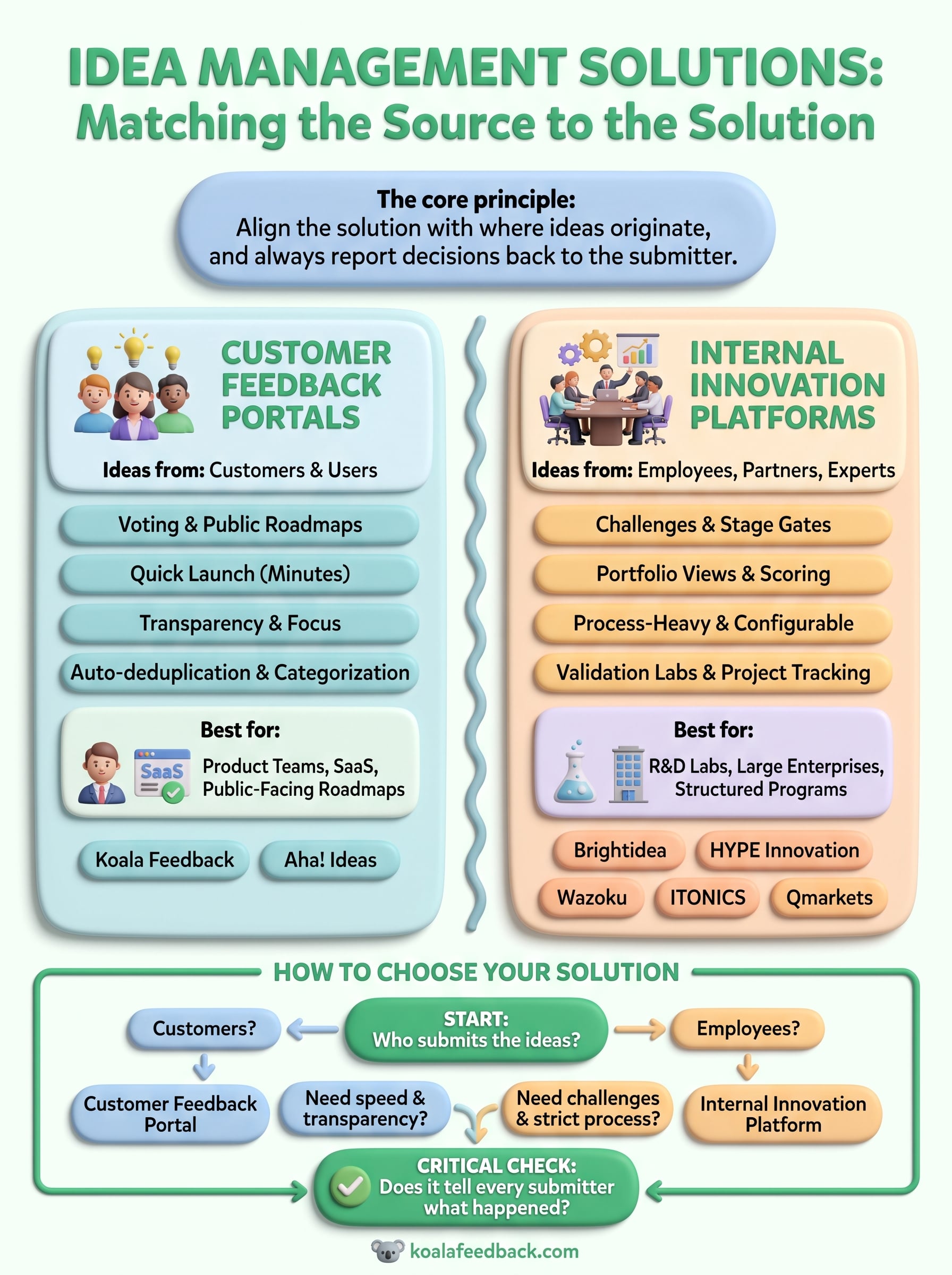
Idea management solutions come in two families. Customer feedback portals favor speed and transparency, and internal innovation platforms favor process, scoring, and portfolio control. Pick the family first, test two or three tools with your own ideas, and judge them by whether submitters get a clear answer.
If your ideas come from customers and you want a ranked roadmap without a long rollout, set up a free Koala Feedback portal and see how your first requests look on a public board.

Start today and have your feedback portal up and running in minutes.