You keep hearing the term in SaaS circles, but the definition changes depending on who you ask. Some people treat it as a fancy name for support. Others describe it as a sales add-on. Neither is quite right, and the confusion makes it hard to hire for, build, or plan a career around.
Customer success is a proactive business strategy and function focused on helping customers reach their goals with your product, so they stay, grow, and recommend you. Customer service reacts to problems. Customer success works ahead of them. A customer success manager (CSM) owns that relationship, from onboarding through renewal and expansion.
This guide covers what the role involves day to day, how the strategy works, and what a career path looks like, including skills and typical progression. We also show where customer feedback fits in. At Koala Feedback, we see teams use feedback portals and public roadmaps to spot churn risks early and show customers they are heard. That habit sits at the core of strong customer success.
SaaS companies don't sell a product once and move on. They sell access, and customers can cancel at the next billing date. That makes recurring revenue only as stable as the customer's reason to stay. Customer success exists to protect that reason and strengthen it.
Consider what it costs to acquire a customer. Say you spend $1,200 on sales and marketing to land an account that pays $100 a month. You need 12 months of revenue just to break even, before you pay for hosting, support, or development. A customer who leaves in month six is a net loss for you.
Churn also compounds. A 3% monthly churn rate sounds small, but it means you lose roughly 31% of your customers every year. You then spend the next year refilling a leaky bucket. Teams that cut churn by a single point often grow faster than teams that simply buy more leads.
Every renewal is earned in the months before it comes due, not in the week the invoice goes out.
Customers rarely cancel because of one bad day. They leave because they never got real value from the product, or because nobody noticed they had stopped logging in. A customer success team closes that gap by working on outcomes instead of tickets.
The benefits of customer success show up in four places:
| Area | Without customer success | With customer success |
|---|---|---|
| Onboarding | Customers figure it out alone | Guided path to a first win |
| Churn | You learn about it at cancellation | Risk spotted from usage and sentiment |
| Expansion | Upgrades depend on random sales calls | Growth follows proven results |
| Product insight | Feedback scattered across emails and calls | Patterns reach the product team |
Expansion deserves special attention. Customers who hit their goals add seats, move up a tier, or buy a second product. When that growth outweighs the revenue you lose to cancellations, your net revenue retention climbs above 100%. That means your existing base grows on its own, which is the healthiest position a SaaS business can be in.
Feedback ties these pieces together. When customers can post ideas, vote on requests, and see statuses on a public roadmap, you stop guessing what they need. A portal like Koala Feedback gives your team that single source of customer voice, so a CSM can see in seconds whether an account has asked for the same missing feature five times.
That knowledge changes the renewal conversation. Instead of walking in blind, the CSM can say the feature is planned for next quarter, or admit it isn't on the roadmap and suggest a workaround. Either answer builds more trust than silence, and trust is what keeps customers around.
A customer success strategy is a plan for how you guide customers from signup to renewal and growth. You don't need a big team to start. You need clear outcomes, honest data, and a repeatable routine your team can run every week.
Begin with the customer's goal, not your feature list. Ask every new account why they bought and what result would make the purchase worth it. A project tool might hear "ship releases without status meetings." That is a desired outcome, and it gives you a measurable first win to build your customer onboarding process around.
Define success in the customer's words, then build every touchpoint around it.
Next, decide how much attention each account gets. Contract value and product complexity should set the level, because a $50 plan can't fund the same care as a $50,000 contract. Matching effort to account size keeps a small team from burning out.
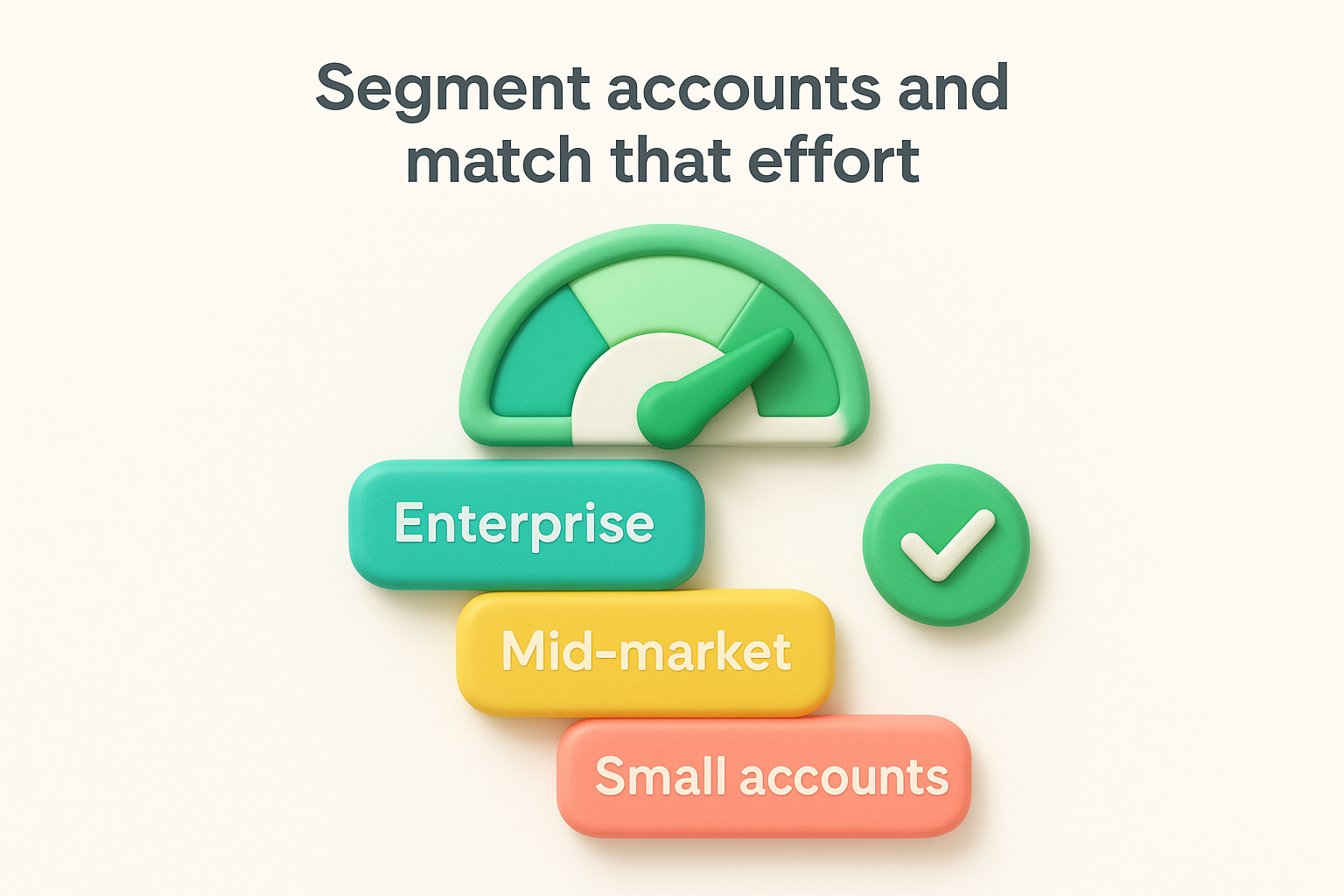
| Segment | Model | Example touchpoints |
|---|---|---|
| Enterprise | High touch | Named CSM, quarterly business reviews |
| Mid-market | Medium touch | Scheduled check-ins, group webinars |
| Small accounts | Tech touch | Email sequences, in-app guides, help center |
Then pick three to five signals that predict churn, such as login frequency, feature adoption, support volume, and survey scores. Pair each signal with a playbook, a short written response anyone on the team can follow. For example:
Finally, close the customer feedback loop. Collect requests in one place, such as a feedback portal, and tell customers what happened to them. A public roadmap with statuses like planned and in progress shows that feedback leads to action. It also gives your CSMs something concrete to share at renewal, instead of vague promises.
These roles share the same customers, so the customer success vs customer service distinction gets blurred. The cleanest way to tell them apart is to ask what triggers the work and what outcome it aims for.
Service and support teams step in when a customer raises a problem. Someone can't log in, a report fails, or an invoice looks wrong. The job is to fix it fast and close the ticket. Many companies use "customer service" and "customer support" interchangeably, though support usually implies technical troubleshooting.
A CSM works before anything breaks. They watch usage, compare progress against the goals the customer set, and reach out when numbers dip. Support closes tickets. Customer success closes the gap between what a customer bought and what they actually achieved.
Support answers the question a customer asks. Customer success answers the one they haven't thought to ask yet.
Account managers own the commercial relationship: renewals, pricing, upsells, and contract terms. Their targets are revenue. A CSM's targets are outcomes, with revenue following from them. In smaller SaaS companies one person often does both jobs. That works if the customer's goals stay ahead of the quota.
Here is how the three functions differ in practice.
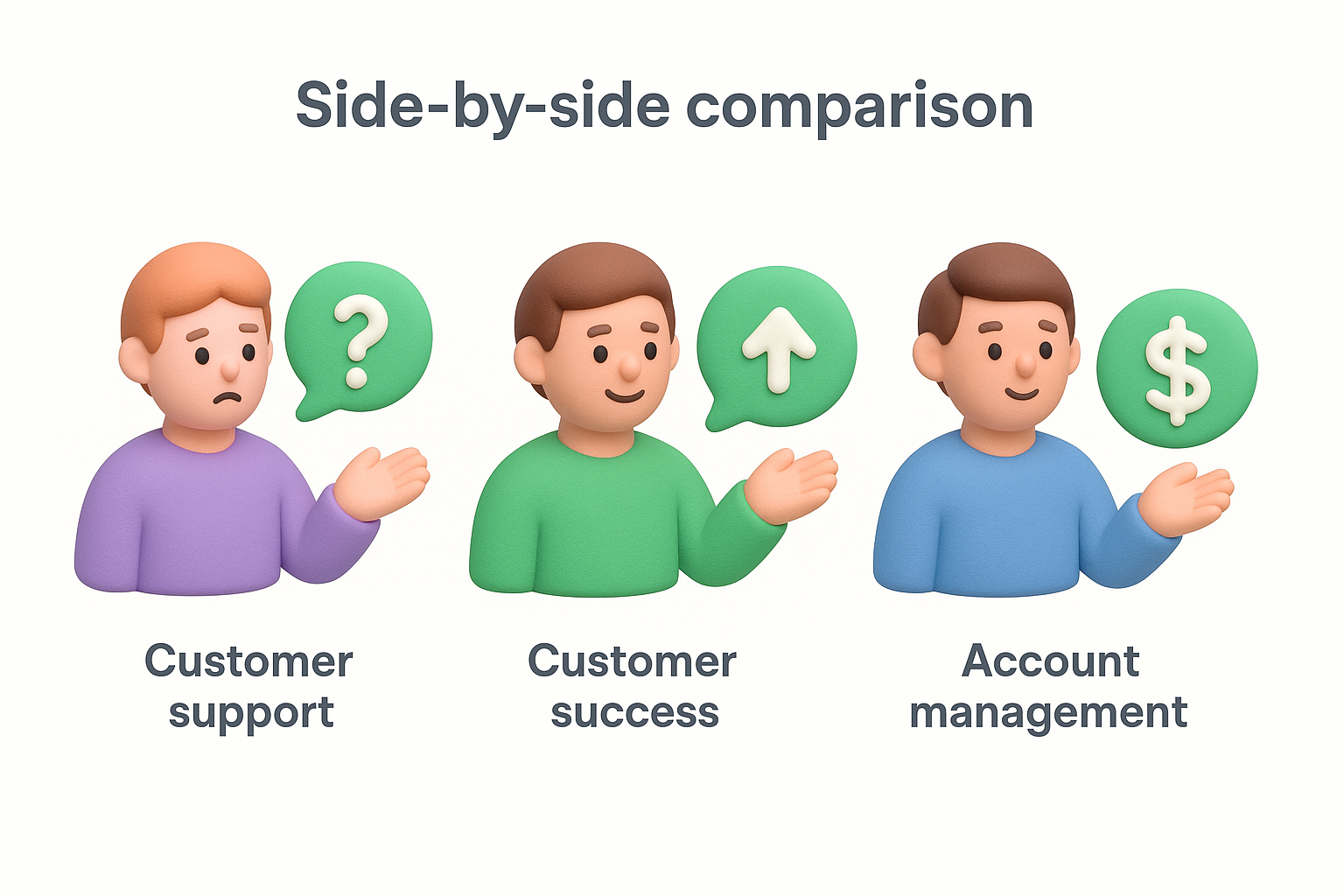
| Customer support | Customer success | Account management | |
|---|---|---|---|
| Starts when | Customer reports a problem | Onboarding begins | Renewal or upsell window nears |
| Approach | Reactive | Proactive | Commercial |
| Core goal | Fast resolution | Customer outcomes | Contract and revenue growth |
| Typical metrics | Response time, CSAT | Retention, adoption, NRR | Quota, renewal rate |
When the functions work well together, information flows both ways. A CSM who sees the same ticket repeat across five accounts should flag it to the product team. Support, in turn, should alert the CSM when a key account files three tickets in a week.
The daily work of a customer success manager varies, but it follows a pattern. Most of it falls into onboarding, monitoring, outreach, and internal coordination. Your caseload sets the pace. An enterprise CSM might own 10 to 15 accounts, while a tech-touch CSM covers hundreds of accounts with help from automation.
Mornings usually start with a health check. You scan usage dashboards, survey scores, and open tickets, then decide which accounts need contact today. From there, the week fills with a familiar set of activities:
The best CSMs spend more time preventing problems than solving them.
Internal work takes more time than newcomers expect. A good CSM spends hours each week translating customer needs for product, support, and sales. Reading a feedback portal such as Koala Feedback helps here, because you can bring vote counts and comments to a planning meeting instead of anecdotes.
Communication comes first. You explain technical ideas in plain language, run calls that end with clear next steps, and deliver bad news early. Empathy and curiosity matter just as much, since customers rarely tell you what is actually wrong on the first try.
Commercial awareness is the skill people overlook. You don't need to carry a quota, but you do need to understand pricing, contract terms, and renewal timing well enough to see when a customer has outgrown their plan.
Customer success tools support those habits. Most teams use a CRM or a dedicated customer success platform, a product analytics tool, and a feedback portal. Comfort with spreadsheets and basic data analysis lets you back your instincts with numbers, which is where the next section picks up.
Customer success metrics turn the instincts of customer success into evidence you can defend in a budget meeting. Pick a handful, read them together, and review them on a fixed schedule. A single number never tells the whole story.
Most teams start with retention and revenue numbers, then add measures of adoption and sentiment. This starter set covers the ground without drowning you in dashboards.
| Metric | What it tells you | How to calculate it |
|---|---|---|
| Customer churn rate | Share of customers you lost | Customers lost ÷ customers at start of period |
| Net revenue retention (NRR) | Whether your existing base grows or shrinks | (Starting MRR + expansion minus contraction minus churn) ÷ starting MRR |
| Time to first value | How well onboarding works | Days from signup to the customer's first key outcome |
| Product adoption | Use of the features tied to the customer's goal | Active users of a key feature ÷ total users |
| CSAT or NPS | How customers feel | Survey responses |
Survey scores show how customers feel, but treat them as a prompt for a conversation. A score of 6 means little until you read the comment behind it.
Churn and NRR are lagging indicators. By the time they move, the customer has already decided. Adoption, time to first value, and survey scores are leading indicators, and they give you weeks of warning. Build your health score from leading signals, then use the lagging ones to check whether your playbooks actually work.
Lagging metrics tell you what happened. Leading metrics tell you who to call today.
Data helps only when it triggers a response. Here is a routine that keeps the numbers from sitting in a dashboard:
Finally, start small. Three metrics tracked consistently beat fifteen tracked loosely, and you can always add more once the routine sticks.
Customer success is one of the more open fields in SaaS for career changers. Employers hire for communication, curiosity, and judgment more than for a specific degree, and you can build proof of all three before you hold the title.
Most people arrive from support, sales, account management, teaching, or consulting. Those jobs teach you to handle customers, which is the hardest skill to train. Entry roles carry titles like customer success associate or specialist, and the career path from there is fairly predictable.
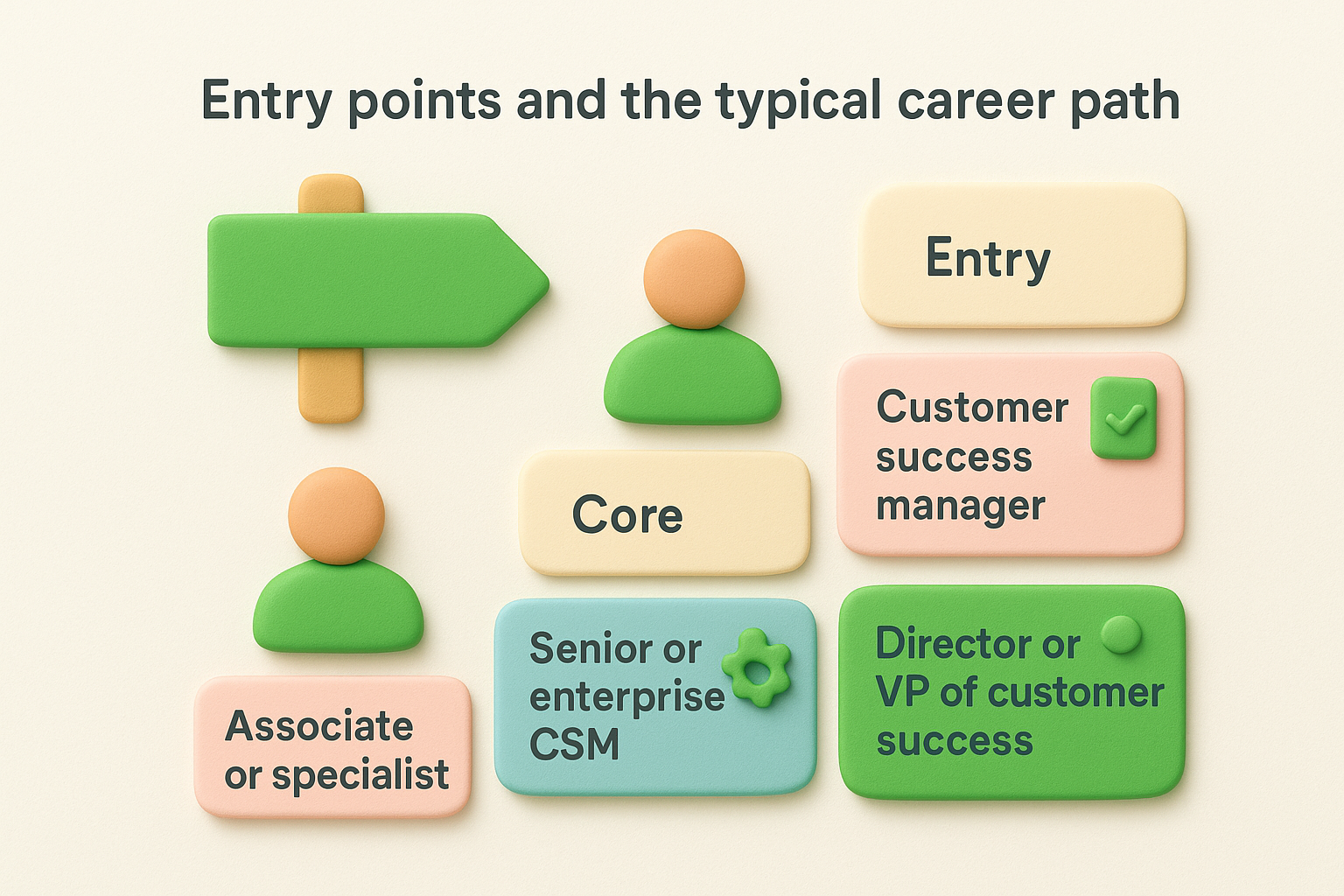
| Stage | Typical title | Focus |
|---|---|---|
| Entry | Associate or specialist | Onboarding, tech-touch accounts |
| Core | Customer success manager | Own a portfolio, renewals, expansion |
| Senior | Senior or enterprise CSM | Strategic accounts, mentoring |
| Leadership | Director or VP of customer success | Strategy, hiring, team metrics |
Pay varies by company size, segment, and whether the role carries a bonus tied to renewals, so compare the full package instead of base salary alone.
Hiring managers want evidence, so create it. Each item below becomes a portfolio piece you can discuss in an interview:
Show that you can improve a customer's outcome, and the title tends to follow.
Resumes for this field should lead with outcomes, not duties. Write "cut churn in a 120-account book by two points" instead of "managed accounts." If you lack numbers, use adoption, response time, or satisfaction results from past jobs.
Expect scenario questions, such as: a customer's usage dropped 40% this month, so what do you do? A strong answer checks the data first, then reaches out with a specific offer of help instead of a generic check-in. Ask your own questions too. Find out the caseload, the segment you would cover, and who owns renewals.
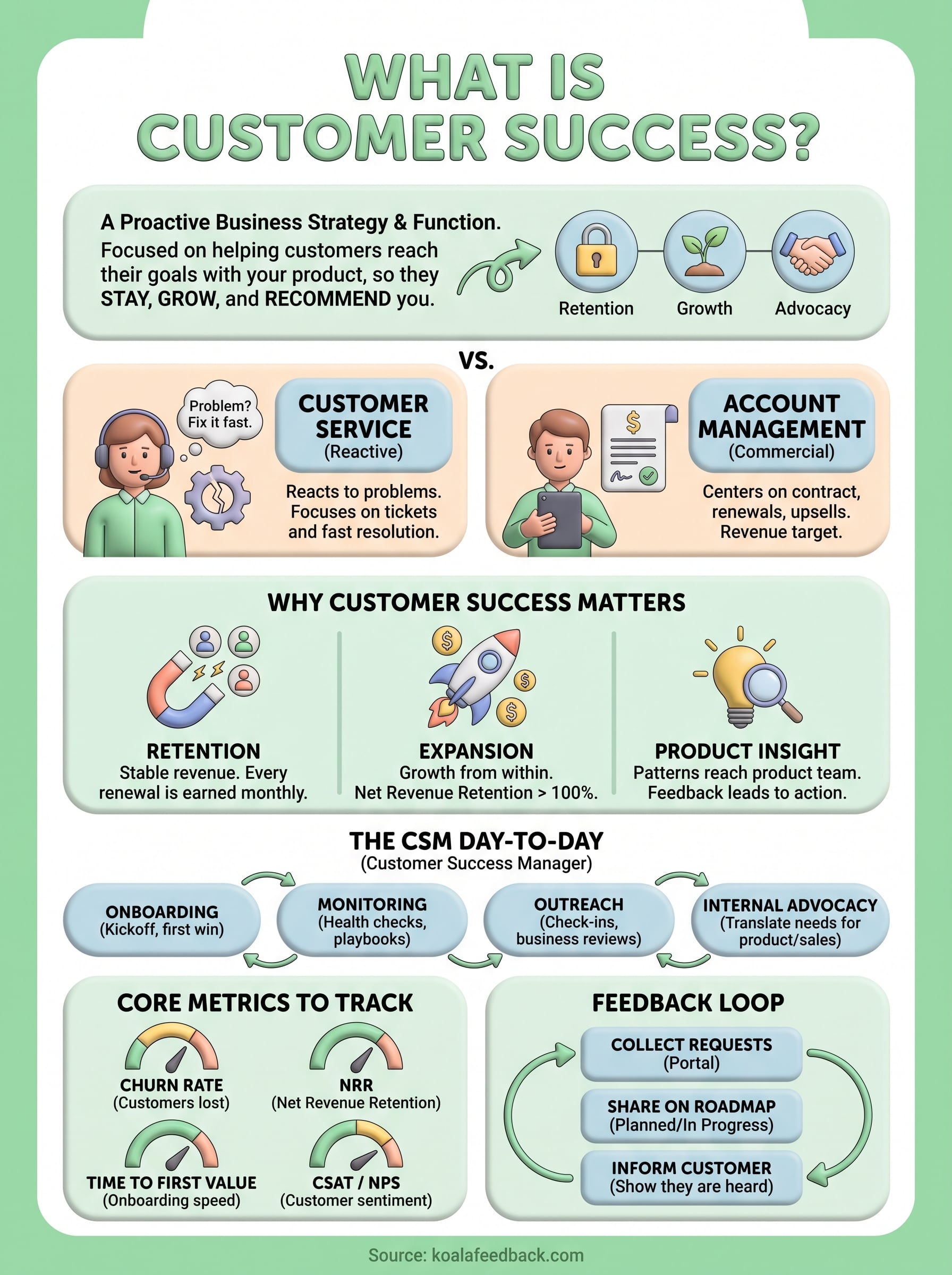
Customer success comes down to one idea: help customers reach their goals, and retention, expansion, and referrals follow. It works ahead of problems, which separates it from support, and it puts outcomes before quota, which separates it from account management.
Start small. Define success in your customers' words, track three metrics, write a few playbooks, and review account health every week. Whether you are building a team or planning a career, the habit that matters most is listening early and acting where customers can see it.
Feedback makes that habit easier to keep. If you want one place to collect requests, let customers vote, and show progress on a public roadmap, try Koala Feedback and give your customers a voice they can watch turn into action.

Start today and have your feedback portal up and running in minutes.