Customer success means helping your customers achieve their goals with your product or service. It goes beyond fixing problems when they arise. Your customer success team proactively guides users to extract maximum value from what they purchased, ensuring they see real results. When customers succeed with your solution, they stick around longer, spend more over time, and become vocal advocates who refer others.
This article breaks down the concrete benefits of customer success and shows you how to measure its impact on your bottom line. You'll learn why customer success drives sustainable growth, how to calculate its ROI with real numbers, and which metrics prove it works. We'll cover how customer success improves your product through user insights, how it benefits teams across your organization, and common mistakes that undermine your efforts. Whether you're building your first customer success program or refining an existing one, you'll walk away with a clear understanding of how customer success transforms satisfied users into loyal advocates and measurable revenue.
Your growth strategy depends on what happens after the sale. Acquiring new customers costs five times more than retaining existing ones, yet many businesses still pour resources into acquisition while neglecting the customers they already have. Customer success flips this approach by maximizing the value of each customer relationship over time. When you invest in helping customers achieve their goals, you create a compounding growth engine that reduces your reliance on expensive acquisition channels and builds a more stable, predictable revenue stream.
The benefits of customer success extend beyond simple retention. Your customer success team identifies expansion opportunities, prevents churn before it happens, and turns satisfied users into referral sources. Each retained customer increases your lifetime value while decreasing your average customer acquisition cost. This creates a multiplier effect: as your customer base becomes more stable and satisfied, your cost per customer drops, your revenue per customer increases, and your growth accelerates without proportional increases in spending.
Your renewal rate determines how much revenue you can count on next quarter and next year. Businesses with strong customer success programs maintain retention rates above 90%, which means you can forecast revenue with confidence and plan investments accordingly. When customers renew consistently, you build a foundation that supports sustainable growth rather than the feast-or-famine cycle that comes from relying on new customer acquisition alone.
Predictable revenue lets you scale intelligently because you know how much baseline income you'll generate before adding new customers. Your finance team can model growth scenarios, your product team can prioritize development with confidence, and your sales team can focus on expansion rather than constantly replacing churned accounts. This stability transforms how your entire business operates and gives you the breathing room to invest in long-term initiatives that compound over time.
Customer success creates the predictable foundation that makes aggressive growth targets achievable rather than aspirational.
Existing customers who find value in your product naturally want more of it. Cross-sells and upsells generate revenue at a fraction of the cost of acquiring new customers because you've already proven your value and built trust. Your customer success team spots these opportunities by understanding each customer's goals and identifying where additional features or higher-tier plans would help them succeed. These expansion conversations feel natural rather than pushy because they're grounded in the customer's actual needs and progress.
Expansion revenue grows exponentially as your customer base matures. A customer who starts on your basic plan might upgrade after six months, add team members after a year, and adopt premium features after two years. Multiply that progression across hundreds or thousands of customers, and you create a powerful growth engine that accelerates without requiring proportional increases in marketing spend or sales headcount.
Calculating the return on investment from customer success requires tracking specific financial metrics that connect your CS activities to revenue outcomes. You need to measure both the costs of running your customer success program and the revenue it generates or protects. Your CS costs include salaries, tools, training, and operational overhead, while your returns come from reduced churn, expansion revenue, and decreased support costs. When you quantify these numbers accurately, you can demonstrate exactly how much value your customer success team creates for the business.
The formula itself stays straightforward: subtract your customer success costs from the revenue impact your CS team generates, then divide by those costs. If your CS program costs $300,000 annually and generates $1.2 million in retained and expanded revenue, your ROI equals 300%. This calculation becomes more nuanced when you factor in prevented churn, referral revenue, and reduced support tickets, but the core principle remains the same. Track every dollar your CS team influences, compare it against what you spend, and you'll have your ROI.
Your customer success team's most direct financial impact comes from keeping customers who would have otherwise left. Calculate this by multiplying the number of at-risk customers your CS team saved by their average annual contract value. If your team prevents 50 customers from churning each year, and those customers each pay $10,000 annually, that's $500,000 in protected revenue directly attributable to customer success efforts.

Track which interventions work best by documenting every save and the tactics your team used. When your CSM identifies declining usage patterns and reaches out proactively, record whether that outreach led to renewal. When you run a customer education webinar for accounts showing warning signs, measure how many participants renewed compared to similar accounts who didn't attend. This data helps you refine your approach and proves which CS activities deliver the highest returns.
Prevented churn represents revenue you already earned once through acquisition, making it the most cost-effective dollar you'll ever generate.
Your CS team creates expansion opportunities by deepening product adoption and identifying unmet needs that additional features or higher tiers would solve. Attribute expansion revenue to customer success when CSMs initiate the upsell conversation or when customers expand within 90 days of a strategic CS touchpoint like a business review or training session. This attribution model captures the direct influence your CS team has on account growth without claiming credit for purely sales-driven expansions.
Document the path from CS activity to expansion by tracking customer health scores alongside expansion timing. Customers with rising health scores (driven by CS engagement) who then expand demonstrate clear cause and effect. When your data shows that accounts receiving quarterly business reviews expand at twice the rate of those without such reviews, you've quantified a specific CS activity's impact on revenue growth.
The benefits of customer success extend beyond direct revenue impact to operational improvements that reduce costs throughout your organization. Your support team handles fewer escalations when CS proactively addresses issues, your product team receives better feedback that reduces wasted development time, and your sales team closes deals faster with customer references your CS team cultivates. Quantify these efficiency gains by measuring support ticket reduction, time-to-close improvements, and reference-influenced deal velocity. When you add these savings to your ROI calculation, the full value of customer success becomes clear and often transforms skeptics into advocates.
The benefits of customer success manifest across every part of your business, from immediate revenue protection to long-term competitive advantages. Your customer success program creates measurable improvements in retention, expansion, referrals, and operational efficiency while simultaneously strengthening your product and brand reputation. These benefits compound over time because satisfied customers who achieve their goals become increasingly valuable as they expand usage, refer others, and provide insights that improve your offering. Understanding each benefit helps you prioritize CS initiatives and allocate resources where they'll generate the highest returns.
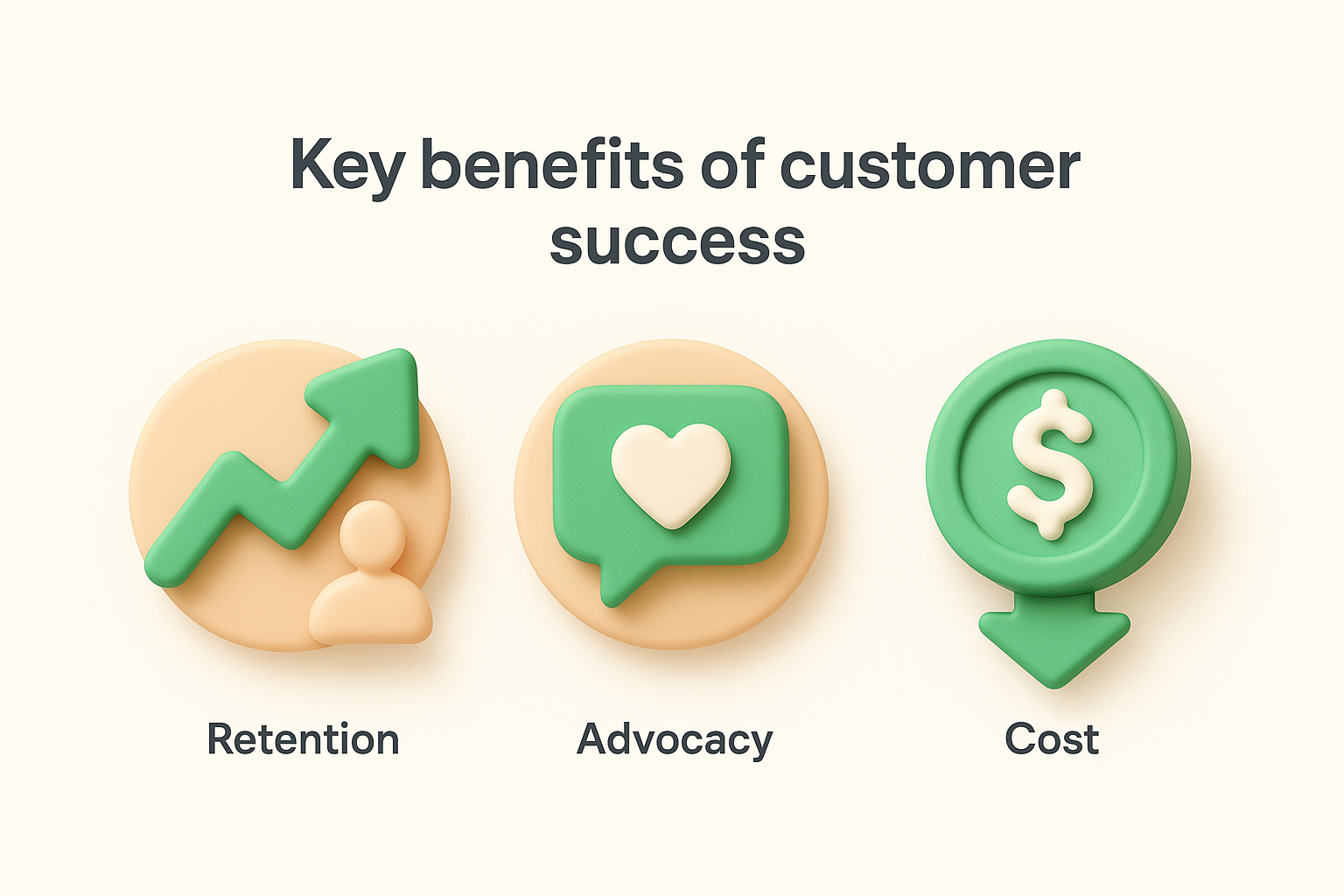
Churn destroys value faster than almost any other business problem because each lost customer takes their future revenue potential with them and often spreads negative sentiment that affects your acquisition efforts. Your customer success team identifies warning signs like declining usage, support ticket patterns, or engagement drops and intervenes before customers decide to leave. This proactive approach keeps revenue stable and predictable while dramatically increasing how much each customer spends with you over their entire relationship.
Customer lifetime value rises exponentially when you improve retention by even small margins. A customer who stays for three years instead of one delivers triple the revenue while your acquisition cost remains fixed. When you factor in expansion opportunities that only mature customers pursue, the value gap widens further. Your CS team creates this extended timeline by ensuring customers continuously achieve new goals and discover additional value in your solution.
Satisfied customers become your most effective marketing channel because people trust recommendations from peers far more than they trust your advertising or sales messages. Your customer success team cultivates advocates by creating exceptional experiences that make customers eager to share their success stories. These advocates reduce your customer acquisition cost by bringing in referrals who already understand your value and arrive pre-sold on your solution.
Advocacy takes multiple valuable forms beyond direct referrals. Happy customers leave positive reviews that influence prospects researching solutions, participate in case studies that strengthen your sales materials, and provide testimonials that increase conversion rates. They speak at industry events, contribute to your user community, and defend your brand when competitors attack. Your CS team identifies these potential advocates early by tracking satisfaction scores and success milestones, then nurtures those relationships into formal advocacy programs.
Customer advocates deliver leads with twice the lifetime value of those acquired through paid channels because they arrive with built-in trust and realistic expectations.
Traditional reactive support waits for problems to escalate before taking action, which creates emergency situations that require expensive urgent interventions and damage customer relationships. Customer success flips this model by monitoring account health continuously and addressing issues before they become critical. This proactive stance reduces the volume of high-priority support tickets while improving resolution times for issues that do arise.
Support cost reduction comes from preventing problems rather than just solving them faster. When your CS team educates customers on best practices during onboarding, those customers submit fewer tickets throughout their lifecycle. When CSMs catch configuration errors early, you avoid the cascading failures that generate multiple urgent escalations. Your support team shifts from firefighting to strategic improvements because the CS team handles prevention systematically.
Your customer success program needs quantifiable metrics that connect CS activities directly to business outcomes. Tracking the right metrics transforms customer success from a cost center into a proven revenue driver and gives you the data you need to secure budget, justify headcount, and demonstrate ROI to leadership. The most powerful CS metrics measure financial impact, customer behavior changes, and early warning signals that predict churn or expansion. When you monitor these metrics consistently and share them across your organization, you create transparency that builds trust in your customer success program and aligns teams around shared goals.
Net revenue retention (NRR) captures your ability to grow revenue from existing customers by measuring how much revenue your current customer base generates compared to a previous period. Calculate NRR by taking your starting revenue, adding expansion revenue from upgrades and cross-sells, subtracting lost revenue from downgrades and churn, then dividing by your starting revenue. An NRR above 100% means you're growing revenue from existing customers even without acquiring new ones, which demonstrates that your customer success efforts create tangible financial returns.
Best-in-class SaaS companies maintain NRR rates between 110% and 130%, showing that existing customers expand their spending significantly over time. Your CS team drives this metric by identifying expansion opportunities, preventing downgrades before they happen, and ensuring customers extract enough value to justify increased investment. When you track NRR monthly and segment it by customer cohort, you can pinpoint which CS strategies work best and allocate resources to activities that generate the highest returns.
Customer health scores aggregate multiple signals into a single metric that indicates how likely each customer is to renew, expand, or churn. Your CS team builds these scores by combining product usage data, support ticket frequency, feature adoption rates, payment history, and engagement with CS touchpoints. A declining health score triggers intervention workflows that let your team address problems before customers decide to leave, while rising scores identify expansion-ready accounts.
Effective health scoring requires continuous refinement as you learn which signals actually predict outcomes. Start with hypotheses about what matters (login frequency, feature usage depth, support interactions), then validate those assumptions by comparing health scores against actual renewal decisions. You'll discover that some signals you thought mattered barely correlate with retention, while others you overlooked prove highly predictive. This iterative approach transforms your health score from a rough estimate into a reliable prediction tool that guides your CS team's daily priorities.
Customer health scores turn scattered data points into actionable priorities that let your CS team intervene before small issues become cancellation decisions.
Time to value measures how quickly new customers achieve their first meaningful outcome with your product, which directly impacts retention and expansion potential. Customers who reach their initial goals within 30 days renew at significantly higher rates than those who struggle for months without seeing results. Your CS team shortens time to value through structured onboarding, proactive check-ins, and educational resources that guide customers to quick wins rather than leaving them to figure everything out alone.
Track time to value by defining specific milestones that indicate success for different customer segments. For a project management tool, that milestone might be completing a first project; for analytics software, it's generating the first insight that drives a business decision. When you measure how long each customer takes to reach these milestones and correlate that timing with retention rates, you'll identify the optimal window for achieving value and can focus your CS resources on helping customers succeed within that timeframe.
Your customer success team sits at the intersection of user experience and product development, providing insights that transform your roadmap from guesswork into strategic decisions. While your product team might know what features are technically possible, your CS team knows which capabilities actually drive customer outcomes and which fall flat in real-world use. This frontline intelligence helps you build features customers will adopt and pay for rather than wasting development resources on functionality that looks impressive but delivers no measurable value. The benefits of customer success extend beyond retention metrics to fundamentally improving what you build and how you prioritize development work.
Customer success managers interact with users daily and hear unfiltered feedback about what works, what frustrates people, and what prevents customers from achieving their goals. Your CSMs collect this information systematically through business reviews, support interactions, onboarding sessions, and check-in calls, creating a rich database of user pain points that never reach your product team through traditional channels. Support tickets might tell you that a feature is broken, but your CS team tells you why customers needed that feature in the first place and what they were trying to accomplish when it failed.

Aggregate this feedback across your customer base to identify patterns that reveal which problems affect the most users or block the highest-value outcomes. One customer complaining about a reporting limitation might represent an edge case, but fifty customers mentioning the same gap indicates a significant opportunity. Your CS team provides this context by connecting individual complaints to broader trends and helping product managers understand which fixes will generate the greatest impact on retention and expansion.
Customer success feedback reveals not just what's broken, but what's missing from your product that would unlock entirely new use cases and revenue opportunities.
Product usage data shows you which features customers click on, but your CS team explains why they use certain features heavily while ignoring others and what outcomes they achieve with the tools they've adopted. This qualitative context transforms raw analytics into actionable insights that guide development priorities. When your data shows low adoption of a particular feature, your CS team can tell you whether users don't understand it, don't need it, or can't find it in your interface.
CS teams identify feature gaps by tracking which workarounds customers create and which integrations they request most frequently. When multiple customers build the same manual process to compensate for missing functionality, you've found a clear development opportunity that will drive adoption and satisfaction. Your CSMs document these workarounds during customer interactions and present them to product teams with context about the business value customers would gain from native solutions.
Testing new features with real users before full release lets you catch usability problems and validate that new capabilities actually solve the intended problems. Your CS team identifies ideal beta testers from customers who requested specific functionality or who would benefit most from new features, then gathers detailed feedback during testing phases. This early input prevents you from launching features that miss the mark and helps you refine user experience before investing in marketing and sales enablement.
Close the feedback loop by showing customers how their input shaped your product, which reinforces their investment in your success and strengthens loyalty. When you launch a feature that directly addresses pain points your CS team collected, acknowledge the customers who contributed to that development. This transparency builds trust and encourages ongoing participation in your product evolution.
The benefits of customer success ripple through every department in your company, creating alignment around customer outcomes that strengthens collaboration and efficiency. Your CS team acts as the voice of the customer inside your organization, translating user needs into actionable intelligence that helps each team make better decisions. When sales, marketing, product, finance, and leadership all receive regular insights from customer success, they can optimize their work based on real customer behavior rather than assumptions or outdated data. This cross-functional impact transforms customer success from a single department into a strategic asset that elevates your entire business.
Your customer success team generates the most credible sales assets by documenting real customer wins and identifying satisfied accounts willing to serve as references. Sales teams close deals faster when they can connect prospects with customers in similar industries or use cases who achieved measurable results. Your CSMs know which customers love your product, which outcomes they achieved, and which talking points resonate most during their success stories, making it easy to match prospects with relevant references that address specific concerns or objections.
Marketing benefits from CS insights by creating campaigns grounded in actual customer language and proven value propositions. Your CS team reveals which benefits customers care about most and which features drive adoption, helping marketing craft messaging that resonates with your target audience. Case studies, testimonials, and customer quotes that your CSMs collect become powerful content assets that perform better than generic marketing copy because they reflect authentic experiences.
Customer success feedback helps product managers separate features that sound impressive from capabilities that actually drive customer outcomes. Your CS team provides context about why customers request certain features and what business problems they're trying to solve, which prevents your product team from building solutions to the wrong problems. This intelligence reduces wasted development cycles and ensures your roadmap addresses needs that impact retention and expansion.
Engineering teams receive clearer requirements when product managers incorporate CS feedback into specifications. Your CSMs explain how customers actually use your product in production environments, revealing edge cases, workflow patterns, and integration needs that wouldn't surface through typical discovery processes. This real-world context helps engineers build more robust solutions that work the way customers need them to work.
Customer success transforms product development from building features to engineering outcomes that customers will pay for.
Executive teams rely on customer success metrics to forecast revenue with greater accuracy because retention rates and expansion patterns provide leading indicators of future performance. Your CS team's health scores and engagement data help finance model different growth scenarios and allocate resources based on which segments show the strongest potential for expansion. This visibility lets leadership make strategic decisions with confidence rather than reacting to surprises at quarter end.
Board meetings become more productive when you can demonstrate how customer success initiatives directly impact retention, expansion, and lifetime value. Your CS metrics prove that investments in customer outcomes generate measurable returns, which helps leadership secure budget for scaling your program and justifies headcount increases based on portfolio size and complexity.
Implementing customer success poorly can waste resources and damage customer relationships instead of strengthening them. Many companies sabotage their own CS programs by falling into predictable traps that prevent them from capturing the full benefits of customer success. Understanding these mistakes helps you design a program that actually delivers results rather than creating busy work that looks productive but generates no measurable impact. Your CS team needs clear direction, appropriate resources, and realistic expectations to succeed.
Your customer success team should prevent problems before they escalate, but many organizations mistakenly use CSMs as glorified support agents who only engage after customers complain. This reactive approach destroys the fundamental value of customer success by forcing your team to fight fires instead of building relationships and driving adoption. When customers only hear from their CSM during crises, they perceive your CS team as a problem response unit rather than a strategic partner invested in their long-term success.
Proactive outreach based on usage data and health scores prevents most issues before customers ever experience frustration. Your CS team should schedule regular check-ins, share best practices before customers need them, and celebrate milestones to reinforce positive momentum. Reactive support fixes what's broken; proactive customer success ensures things never break in the first place.
Every customer brings different goals, resources, and constraints to their relationship with your product, yet companies often deploy identical onboarding sequences and engagement cadences regardless of customer characteristics. This one-size-fits-all approach wastes CS resources on low-value activities while neglecting high-impact opportunities. Your enterprise customers need strategic business reviews and executive alignment, while your small business customers might prefer self-service resources and quick-win templates.
Segment your customer base by revenue, use case, or maturity level and create tailored CS motions for each segment. High-touch white-glove service makes sense for accounts paying six figures annually, but that same approach becomes unsustainable at scale for customers paying hundreds per month. Build scalable programs that match engagement intensity to customer value and complexity.
Customer success fails when you treat every account identically instead of matching your approach to their specific needs and potential value.
Waiting until renewal conversations to assess customer health guarantees you'll discover problems too late to fix them. Your CS team should monitor engagement metrics, feature adoption patterns, and support ticket trends continuously rather than checking in quarterly or when contracts approach expiration. Customers who stop logging in or who abandon key features signal churn risk months before renewal, giving you time to intervene when there's still opportunity to demonstrate value.
Build automated alerts that flag concerning behavior patterns and trigger CS workflows before small issues compound into cancellation decisions. Track metrics that predict outcomes rather than just measuring results after they happen.
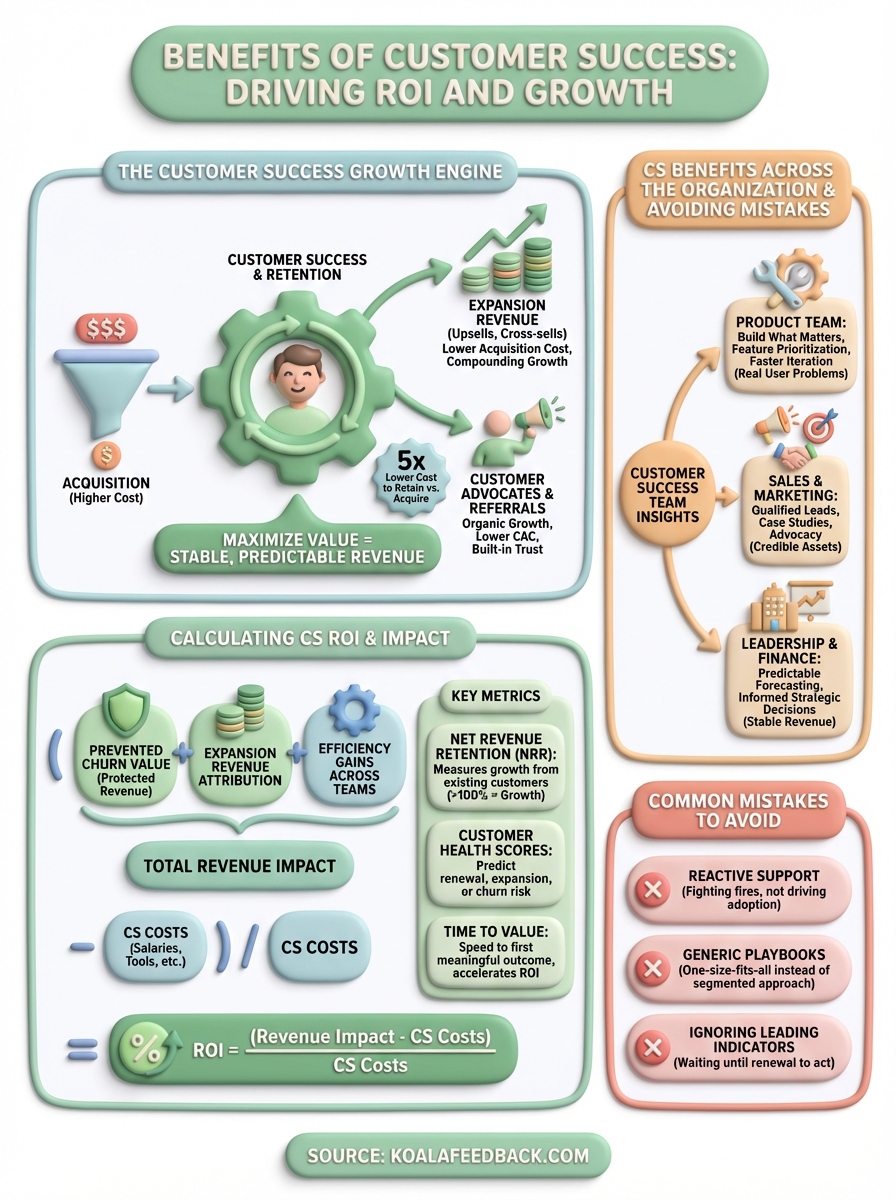
The benefits of customer success extend far beyond preventing churn to create a comprehensive growth engine that compounds over time. Your CS program protects existing revenue, generates expansion opportunities, and provides insights that improve every part of your business from product development to sales enablement. When you invest in helping customers achieve their goals, you build relationships that translate into predictable revenue, lower acquisition costs, and a competitive advantage that strengthens with each satisfied customer. Customer success transforms one-time transactions into long-term partnerships that drive sustainable growth.
Building an effective customer success program requires the right tools to collect feedback, prioritize improvements, and keep customers informed about your progress. Capture user feedback and share your product roadmap with Koala Feedback, giving your customers a voice in shaping features that matter most to their success. Your CS team needs visibility into what customers want and the ability to demonstrate how you're addressing their needs, creating the transparency that builds trust and drives retention.

Start today and have your feedback portal up and running in minutes.