A product mix strategy is the plan a company follows to decide which product lines and individual products it sells, and how it will grow, trim, upgrade, or price them over time. The product mix is the full set of what you offer. The strategy is the set of choices that shapes it: add a line, drop a weak product, launch a premium tier, or sell a cheaper entry option.
This article covers the four dimensions you use to describe a mix, the main strategy types, the pricing approaches that go with them, and real examples. You will also get a simple audit and a five-step process for choosing a strategy for your own portfolio.
Most product mix decisions fail because they rest on opinion instead of evidence. At Koala Feedback we help product teams collect and prioritize user feedback, and that feedback is the best input a mix decision can have. You will see where it fits in the process.
A product mix strategy matters because every product you sell draws on the same limited engineering, marketing, and support time. The strategy decides where that time goes.
A company that depends on one product is exposed. A price change, a new competitor, or a shift in customer taste can cut revenue fast. A balanced mix with several lines spreads that risk.
More products are not automatically better, though. Each extra product adds support tickets, documentation, and roadmap work. A strategy forces you to put resources behind the products with the most growth potential and to stop feeding the ones that have not earned their place.
A product mix is a budget decision: every product you keep is a product you chose not to replace.
Customers differ. Some are price-sensitive, and others want the most capable version. A mix with an entry option and a premium option reaches both. The mix also shapes how the market sees you: a narrow mix reads as a specialist, and a wide one reads as a full-service provider.
Without a strategy, mixes grow by accident. One loud customer asks for something, or a competitor launches a feature and you copy it. Two years later you have lines nobody can explain. A strategy gives you a rule for saying yes and a rule for saying no.
To audit your product mix, measure four things: width, length, depth, and consistency. Together they describe the shape of what you sell and show where a strategy should act.
| Dimension | What it measures | Example |
|---|---|---|
| Width | Number of product lines | An appliance maker with refrigerators, washers, and ovens has a width of 3 |
| Length | Total number of products across all lines | 5 refrigerator models + 4 washer models + 3 ovens = 12 |
| Depth | Variations of one product, such as size, color, or flavor | A refrigerator sold in 3 sizes and 2 finishes has a depth of 6 |
| Consistency | How closely the lines relate in end use, production, and distribution | Shampoo, conditioner, and body wash are highly consistent. Refrigerators plus shampoo are not |
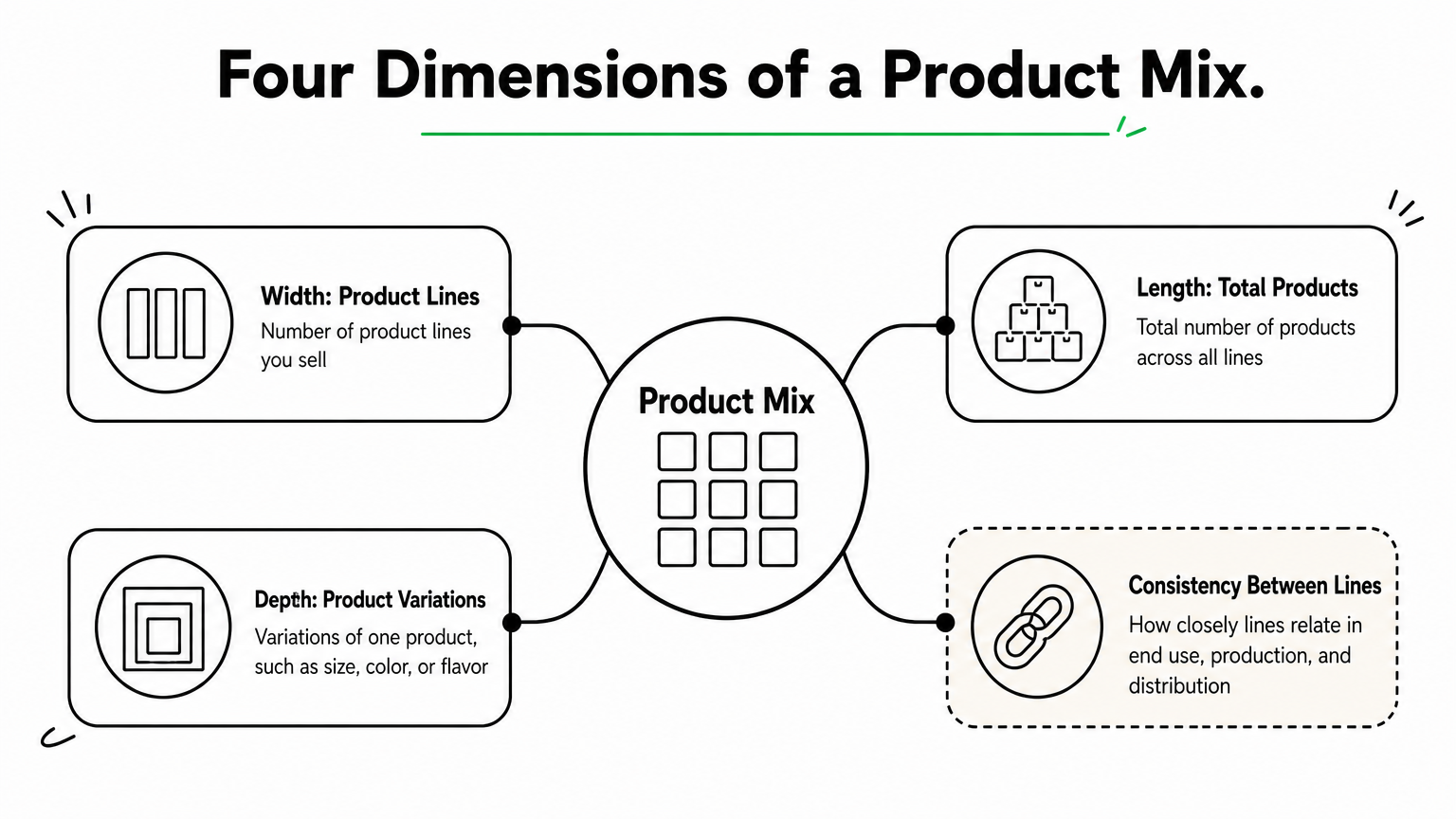
Some authors count length per line instead of across the whole mix. Pick one definition and keep it, so your numbers stay comparable from one review to the next.
Two related terms often get mixed up with the mix itself. A product line is one group of closely related products, such as a set of laptop models. The product mix is all your lines combined. The marketing mix, the 4 Ps of product, price, place, and promotion, is wider still. The product mix is only the "product" part of it.
You can run this audit in a spreadsheet in an afternoon:
Step 5 matters most. Counts describe your mix, but revenue and cost per item turn the description into a decision tool.
Counting your products tells you what you have. Pairing each one with its revenue and cost tells you what to do.
The main product mix strategies are expansion, contraction, trading up, and trading down. Modernization, filling, and differentiation are common additions. Each one changes a different dimension of your mix.
| Strategy | What you do | Dimension it changes | Typical trigger |
|---|---|---|---|
| Expansion | Add new lines, or add variations within lines | Width, depth | Demand for an adjacent need |
| Contraction | Cut weak products or lines, simplify the rest | Width, length | Low usage, high support cost |
| Trading up | Add a higher-priced product to a line | Depth | Customers asking for more power |
| Trading down | Add a lower-priced product to a premium line | Depth | Price-sensitive prospects |
| Modernization | Improve an existing product instead of building a new one | Quality | Shifting customer expectations |
| Filling | Add products that close gaps in a line | Length | Customers buying a complement elsewhere |
| Differentiation | Reposition an unchanged product as the better choice | None | A crowded market with similar products |
Expand when demand data points to an unmet need close to what you already do, and you have the capacity to support it. A software company with a task management tool might add time tracking because its customers keep asking for it.
Contract when a product has low usage and a high support cost. Cutting is not failure. It frees the resources you need for the products that matter, and it simplifies what you have to explain to customers.
Trading up and trading down carry their own risks. Trading up can lift your brand image and make the cheaper options look like good value. Trading down widens your audience, but it can pull buyers away from your premium product and weaken how the brand is perceived.
Pricing a mix is different from pricing one item, because the products affect each other's sales. Five approaches are commonly used:

The clearest examples come from companies that combine several strategies at once. Google shows this at large scale, and a simple software plan ladder shows it at small scale.
Google's mix is wide. Its lines include search and information services (Search, Maps), advertising (Google Ads), cloud (Google Cloud Platform, Google Workspace), hardware (Pixel phones, Nest devices), and media (YouTube).

Its entry into hardware is a clear expansion. Premium Workspace plans with more storage, security, and collaboration tools are trading up. Shutting down the Stadia game streaming service in 2023 is contraction. Consistency is fairly high for a company this size, because the products connect to each other: Search feeds Ads, and Drive links to Docs and Sheets.
At small scale, a plan ladder is a product mix in miniature. Koala Feedback sells one product line in three plans:
| Plan | Price | Boards | Statuses | Active posts |
|---|---|---|---|---|
| Starter | Free | 3 | 5 | 100 |
| Growth | $29/month | Unlimited | 6 | Unlimited |
| Business | $89/month | Unlimited | Unlimited | Unlimited |
All plans are billed annually, so Growth comes to $348 a year and Business to $1,068. In mix terms, that is one line with a depth of three. The free plan is the entry point. Teams move up as they need more boards, more statuses, and unlimited posts.
You do not need many product lines to have a strategy. A well-spaced plan ladder is one.
Choose a strategy by matching what your customers ask for and what your numbers show to one of the seven moves, then test it on one product before you reshape the whole mix.
Feedback tells you which move to make. Repeated requests for something adjacent signal expansion. A product that nobody votes for or uses signals contraction. Power users asking for more control signal trading up. Votes and comments give you counts instead of anecdotes, so the loudest customer stops winning by default.
A feedback tool makes this practical. In Koala Feedback, users submit ideas in a portal, similar requests are deduplicated and categorized, and votes show demand. Boards organized by product area show which line the demand comes from. A public roadmap with statuses then tells customers what you are building and what you are not. Signing up is free.
Two mistakes come up often. Teams widen the mix before they have filled the depth of the lines they already sell. And they retire products without warning users. Announce a contraction early and offer a migration path, so a cut does not become a churn event.
Change one line at a time. A mix you can measure is a mix you can improve.
A product mix strategy is a repeatable habit: describe your mix by width, length, depth, and consistency, then pick the move that fits the evidence. Expand when demand is clear, contract when a product costs more than it returns, and trade up or down when your customers split by budget. Price the mix as a whole, not item by item.
The strongest evidence comes from your users. If you want that evidence in one place, you can collect and prioritize user feedback with Koala Feedback and let real demand guide your next mix decision.

Start today and have your feedback portal up and running in minutes.