A product innovation charter (PIC) is a short written document that tells your product team where new product work should go and where it should not. Senior management usually drafts it. It covers four things: the background for the effort, the markets and technologies to focus on, the goals to hit, and the guidelines that set limits. Think of it as a mission statement for new products.
This article defines the term, explains why it matters, and lists what a charter contains. It then walks you through writing one and gives you a filled-in sample to adapt. The sample company is fictional, but the structure is the one most textbooks and practitioners use.
Product teams that collect feedback in a portal soon hit the problem a charter solves. Hundreds of requests arrive, and without a stated direction they all look equally urgent. A charter gives you the rule for saying yes, not yet, or no.
A product innovation charter matters because it turns company strategy into rules that a product team can apply to every idea. Without one, teams drift toward whatever is loudest: the biggest customer, the newest competitor feature, or the most enthusiastic executive.
A strategy slide says "grow in the mid-market." A charter says which markets, which technologies, which kinds of products, and what return you expect. That lets you test an idea in minutes. It is either inside the stated focus or it is not, and the team gets a shared screening standard instead of a debate.
The filter matters most when feedback volume rises. Each incoming request gets checked against the charter. Requests that fit go on to prioritization, and the rest get a clear, polite decline.
Writing the charter forces leadership to agree on goals and limits before money is spent. That lowers the chance of building something the company cannot sell or support. It also holds the scope of a project, because the technology and market boundaries are written down and a project cannot quietly expand into a new market halfway through.
The charter also feeds product portfolio management. The charter decides which arenas deserve investment. The portfolio process then decides which individual projects inside those arenas get funded.
A charter is the rule you apply to an idea before you spend a day on it.
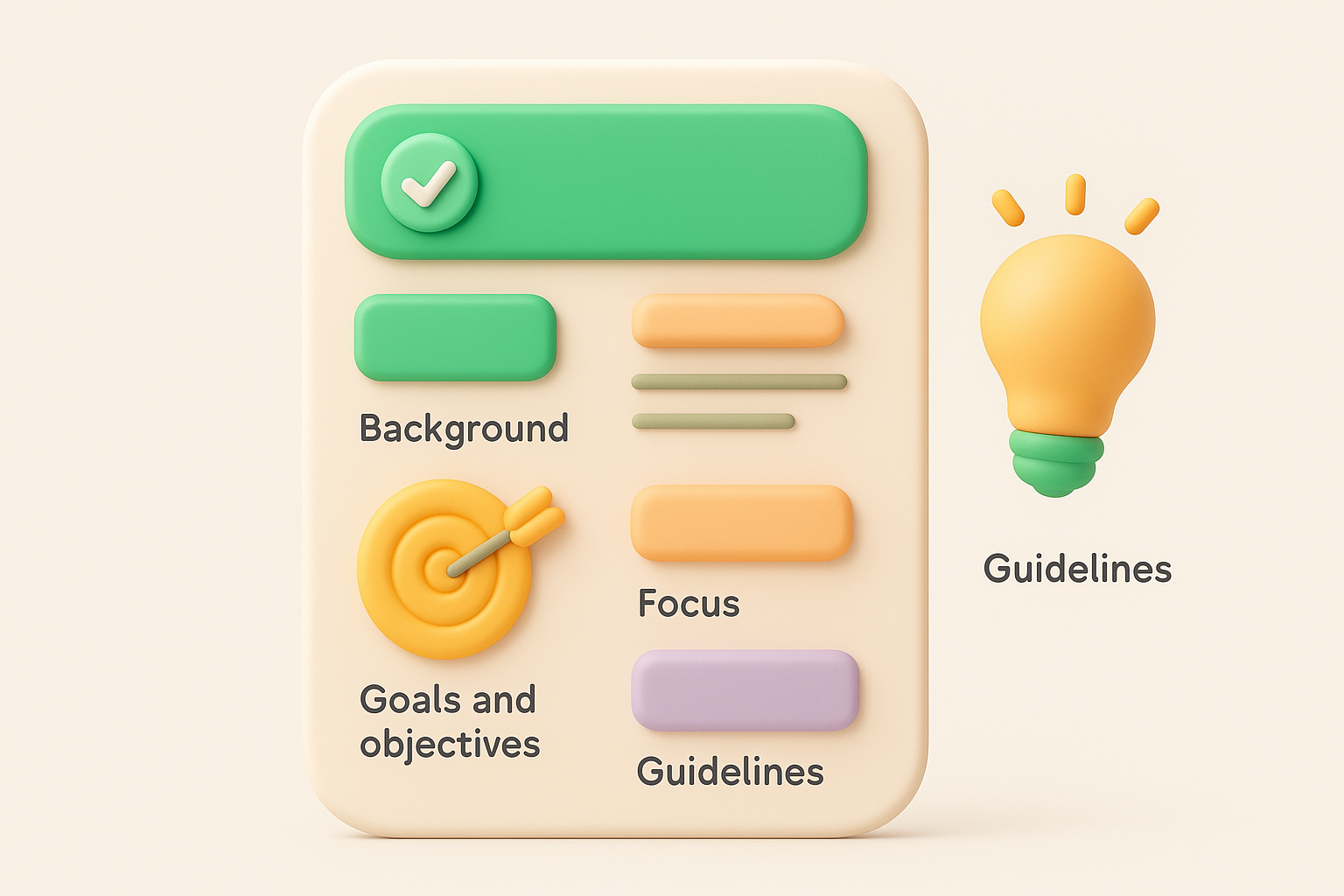
A product innovation charter has four core elements: background, focus, goals and objectives, and guidelines. Some companies add owners, review dates, or success metrics, but these four do the real work.
| Element | Question it answers | What to write |
|---|---|---|
| Background | Why are we doing this? | Link to the company mission, the strategic context, and the evidence of an opportunity |
| Focus | Where will we play? | Target markets, technologies, and product types, plus what is explicitly out |
| Goals and objectives | What does success look like? | Measurable targets with dates, such as revenue, share, retention, or launch timing |
| Guidelines | What limits apply? | Budget, team capacity, risk tolerance, regulatory or brand constraints, review cadence |
The focus section is where most charters succeed or fail. If it excludes nothing, it filters nothing. Name the markets and technologies you will pursue, and name at least two you will not.
A vision describes the long-term future you want. A roadmap lists planned work over time. The charter sits between them and sets the boundaries for what can earn a place on the roadmap. The word "charter" here means a mandate, as in a project charter. It does not describe a type of product.
The charter is usually internal. The roadmap is where its effects become visible to customers. A public roadmap with statuses like planned, in progress, and completed shows users the result of charter decisions without exposing the strategy behind them.
The vision says where you are going, the roadmap says what ships next, and the charter says what is allowed on the road.
To write a product innovation charter, start from corporate strategy, back each element with evidence, and test the draft against real ideas before you publish it. Plan on a few working sessions with senior leaders, not a solo writing task.
Keep it to one or two pages. A charter nobody reads cannot filter anything, and long ones tend to turn into strategy essays. Write each element so a product manager can apply it without asking the author what it means.
Avoid the common failures. Do not write goals that are only financial, because teams then ignore customer outcomes. Do not write the charter without the people who must apply it, since they will spot vague wording fast. And do not file it away: a charter that never gets revisited drifts out of step with the market.
If a product manager cannot use the charter to reject an idea in five minutes, rewrite it.
The sample below is a filled-in charter for an imaginary project management tool for small agencies. All figures are invented for illustration. Replace each line with your own evidence and targets.
PRODUCT INNOVATION CHARTER: Acme Planner (fictional)
Period: 2027 to 2028

1. BACKGROUND
Mission: help small agencies plan client work without spreadsheets.
Why now: yearly logo churn is 18%. Customer feedback points to
missing client reporting and no client-facing view of progress.

2. FOCUS
Markets: US agencies with 5 to 50 staff.
Technology: web app, calendar and invoicing integrations.
Product types: new features for the existing planner.
Out of focus: enterprise resource planning, native mobile apps,
new standalone products.

3. GOALS AND OBJECTIVES
- Grow revenue from this segment by 25% within 24 months.
- Cut yearly logo churn from 18% to 12%.
- Release the first version of client reporting within 9 months.

4. GUIDELINES
- Development capacity capped at two teams.
- One major bet at a time.
- Each major bet needs validation from customer interviews
  or feedback votes before build starts.
- No storage of payment card data.
- Leadership reviews this charter every 6 months.
Take a feature request such as "add a native iOS app." The charter lists native mobile apps as out of focus, so the team declines it quickly and explains why. A request for "shareable client progress reports" fits the focus, supports the churn goal, and moves on to prioritization.
If you run a feedback portal, this check is simple to apply. Organize requests into boards by product area, and use roadmap statuses to show which ideas are planned, in progress, or done. Requests outside the charter get a clear answer instead of sitting open for months.
A good sample is not a script. It shows the level of specificity your own charter needs.
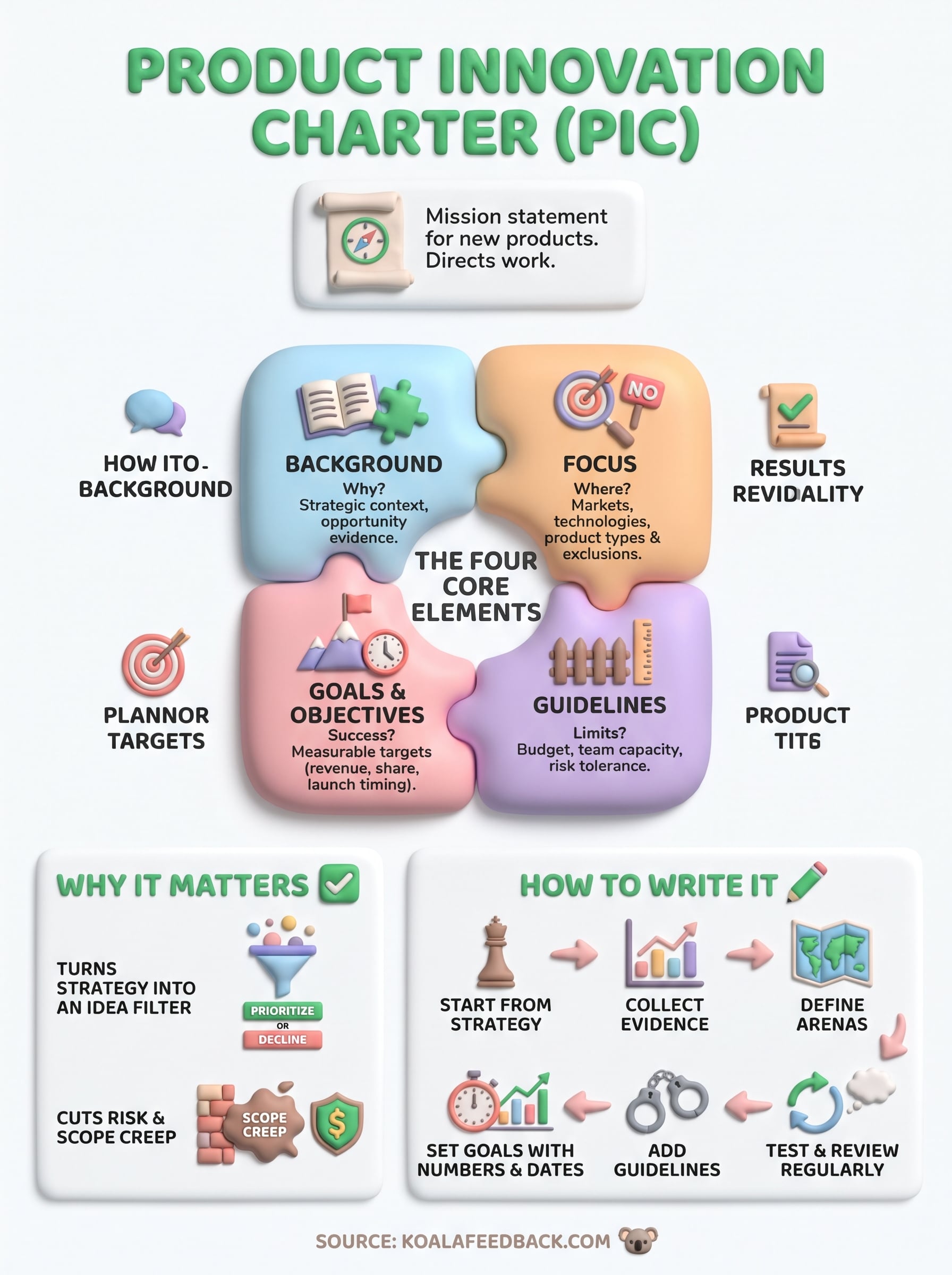
A product innovation charter gives new product work a purpose, a boundary, and a measure of success. It has four elements: background, focus, goals, and guidelines. It stays short, it names what is out of scope, and leaders revisit it as strategy changes. The sample above shows how little text it takes to turn a vague strategy into rules a team can apply.
Once the charter exists, feedback becomes easier to handle. Each request either fits the focus or it does not, and your roadmap can reflect that. If you want a place to collect requests, sort them by product area, and share progress with users, try Koala Feedback and set up your feedback portal and public roadmap. Signing up is free.

Start today and have your feedback portal up and running in minutes.