Most failed products don't fail because teams built them badly. They fail because nobody checked if anyone wanted them in the first place. That's the gap between product development and market research, two processes that work best when they run together instead of one after the other.
If you're trying to figure out where research fits into your build process, here's the direct answer: market research in new product development isn't a single phase you complete before design starts. It's a continuous input that shapes what you build, informs how you prioritize features, and tells you whether your roadmap actually matches user demand. Skip it, and you're guessing.
This article breaks down how new product development market research actually works in practice: the specific methods teams use to validate ideas, the stages where research matters most, and how to turn raw feedback into decisions your team can act on. We'll also look at how tools built for centralizing user input, like feedback portals and prioritization boards, make this connection easier to manage day to day.
Most teams skip research because they think they already know what users want. That assumption is expensive. Product development and market research work together precisely because internal opinions, no matter how experienced the team, are a poor substitute for actual user behavior. You can build a feature that every stakeholder loves in a meeting and still watch adoption sit at 2% six months later. Research closes that gap before you spend engineering hours finding out the hard way.
Building software is expensive, and rebuilding it is worse. A poorly validated feature doesn't just cost the sprint you spent on it, it costs the opportunity cost of what you could have built instead. Market research and new product development are risk-reduction partners: research narrows the range of things you could build down to the things worth building. When you validate demand before writing code, you catch mismatches between what your team assumes users need and what they'll actually pay for or use regularly.
The cost of research is always cheaper than the cost of an unwanted feature.
Consider two companies launching similar SaaS products. One skips research and builds based on founder intuition. The other runs structured customer interviews and analyzes support tickets before committing engineering time. The second company still makes mistakes, nobody avoids that entirely, but they make fewer of them and correct course faster because they built a habit of checking assumptions against real signals.
Teams naturally overvalue the loudest voice in the room, whether that's a persuasive salesperson relaying a client complaint or an executive pushing a pet feature. Structured research gives you a counterweight. Instead of prioritizing based on who spoke up last, you prioritize based on patterns across dozens or hundreds of users. This is where new product development market research earns its place in the process rather than being treated as an academic exercise.
A public feedback portal makes this alignment visible. When users vote on requests instead of just emailing individual complaints, you see actual demand volume instead of anecdote. A request with 200 votes tells a very different story than one email from a single frustrated customer, even if that email was memorable.
Here's the part teams underestimate: research done early actually makes later decisions faster, not slower. Once you have data on what users want and why, prioritization conversations shrink from hour-long debates to quick reviews of evidence. Roadmap planning meetings stop being negotiation sessions between competing opinions and start being exercises in reading the data you already collected.
Skipping research doesn't eliminate this work, it just moves it later and makes it more expensive. Instead of a two-week validation sprint, you get a six-month build followed by a painful realization that adoption isn't happening. The following comparison shows how the cost shifts depending on when you validate:
| Validation Timing | Typical Cost | Risk Level |
|---|---|---|
| Before development (surveys, interviews, portal votes) | Days to a few weeks | Low |
| During development (beta feedback, prototype testing) | Weeks to a couple months | Medium |
| After launch (usage data, churn, support tickets) | Months, plus lost engineering time | High |
One mistake worth naming here, and we'll cover more in a later section, is treating research as a box to check before kickoff. Product teams that get the most value from research treat it as an ongoing loop: collect feedback, prioritize based on patterns, ship, then collect again to see if the fix or feature actually solved the problem. Each cycle sharpens your understanding of what users actually need versus what they say they need in the abstract.
Users rarely articulate solutions clearly. They describe frustrations, workarounds, and symptoms of a problem, and it's your job to translate that into a feature that solves the underlying need. That translation only gets more accurate the more consistently you're gathering signal, which is why the strongest product teams build research into their weekly rhythm rather than reserving it for quarterly planning.
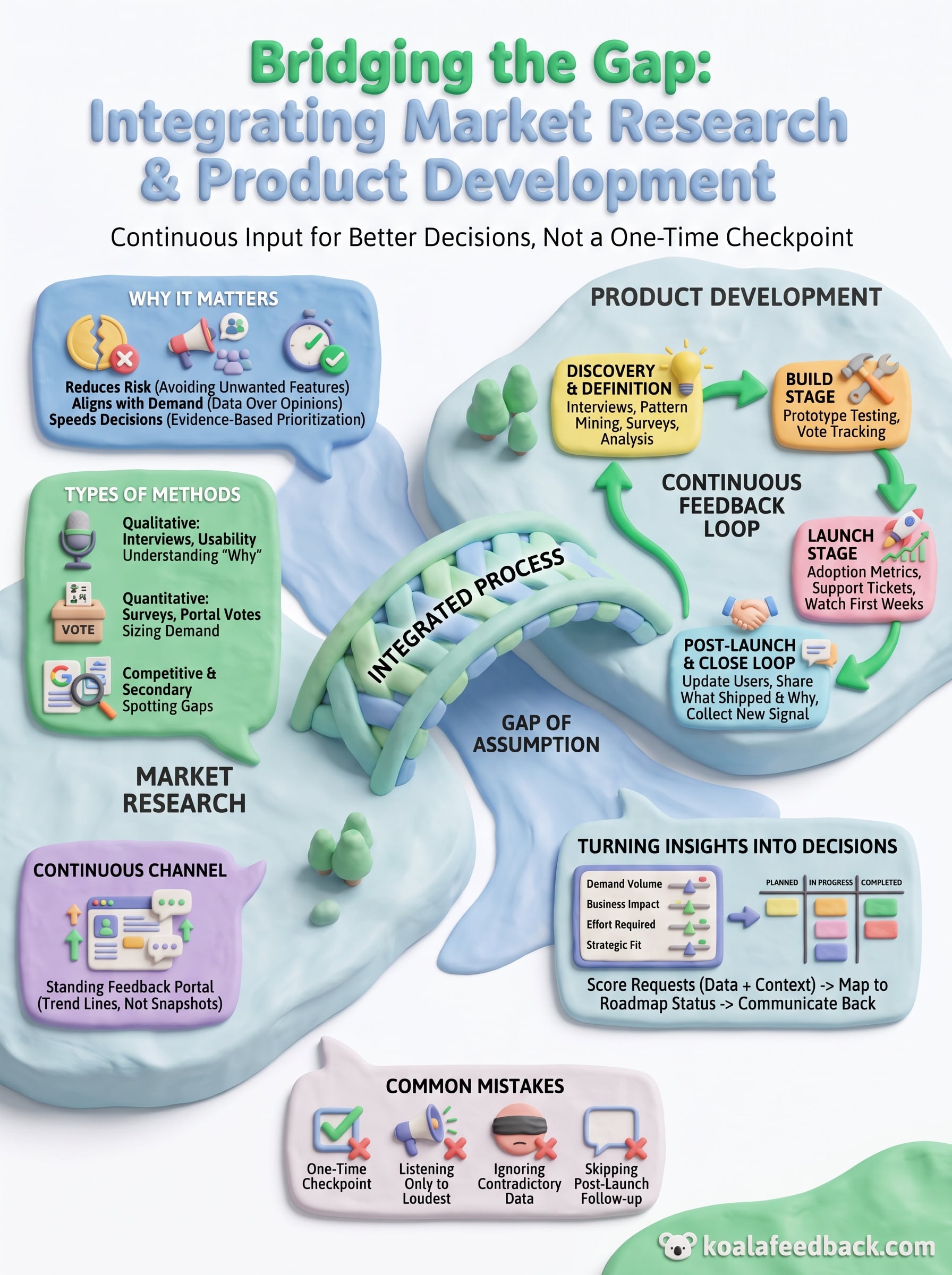
Getting product development and market research to work together isn't about adding a research phase to your existing timeline. It's about mapping specific research activities to specific stages of the process, so every decision point has evidence behind it instead of guesswork. Teams that do this well don't treat research as a gate you pass through once. They treat it as a set of checkpoints built into the workflow itself.
Start by identifying where decisions actually get made, then attach a research method to each one. This keeps research proportional to the size of the decision instead of applying the same heavyweight process everywhere.
Research isn't a phase you finish. It's a checkpoint you repeat at every stage of the build.
One-off surveys give you a snapshot. A standing feedback channel gives you a trend line. Instead of scheduling a survey every quarter and hoping it catches what matters, set up a permanent channel where users submit ideas, vote on what they care about, and comment on existing requests. This turns your feedback portal into a living research instrument that updates itself, rather than a project you have to relaunch every few months. It also solves a problem ad hoc research can't: you see how demand for a request changes over time, not just a single moment.
Research dies quietly when nobody owns it. Name a specific person, usually a product manager, responsible for reviewing incoming feedback on a set schedule, whether that's weekly or biweekly, and reporting patterns back to the team. Without a named owner, feedback piles up in an inbox and never makes it into a prioritization board. With one, market research in new product development stops being a sporadic project and becomes a habit the whole team can rely on when planning the next sprint.
Not every idea needs the same depth of research. A small tweak to an existing feature might only need a quick poll on your feedback portal, while a new product line deserves interviews, surveys, and competitive analysis before you write a single line of code. Matching the method to the size of the decision keeps product development and market research efficient instead of turning every idea into a weeks-long study.
Customer interviews remain the fastest way to understand why users want something, not just that they want it. A 30-minute call can surface context that a survey never will, like the workaround someone built because your product doesn't support a specific workflow. Focus groups work similarly but at a slightly higher risk of groupthink, so weigh individual interviews more heavily when the stakes are high.
Surveys tell you what users want. Interviews tell you why they want it.
Usability testing on early prototypes fits here too. Watching someone actually try to use a feature reveals friction that no amount of feedback-form text can describe. Pair this with comments on your feedback portal, since users who've already left detailed written context often make great candidates for a short follow-up call.
Surveys and portal voting data give you scale. Instead of five interview opinions, you get patterns across hundreds of users. A feature request with 300 votes and dozens of comments tells you demand is broad, not just loud. This is where market research and new product development intersect most clearly with prioritization, since vote counts become an input directly feeding your scoring model.
Usage analytics from your existing product round this out. If a competing internal idea already has behavioral data behind it, like a workaround feature that gets heavy use despite being clunky, that's a stronger signal than a hypothetical survey response.
Looking at what competitors offer isn't about copying features. It's about understanding what's now considered table stakes in your category and where a gap exists. Pair this with industry reports and analyst commentary for a wider view of the market, and check government or trade sources like the U.S. Bureau of Labor Statistics or U.S. Census Bureau when your product touches broader economic or demographic trends.
| Method | Best For | Speed | Sample Size |
|---|---|---|---|
| Customer interviews | Understanding motivation | Slow | Small |
| Surveys | Sizing demand | Medium | Large |
| Portal voting/comments | Continuous signal | Fast | Ongoing |
| Usability testing | Catching friction | Medium | Small |
| Competitive analysis | Spotting gaps | Medium | N/A |
Combining a couple of these methods almost always beats relying on one alone.
Collecting feedback is only half the job. The real value of product development and market research shows up when you turn a stack of interview notes, survey results, and portal votes into an actual roadmap decision. Teams that struggle here usually have plenty of data and no consistent way to weigh it, so the loudest opinion in the room still wins even after the research is done. The fix is a repeatable framework that turns qualitative color and quantitative volume into a single, defensible priority score.

Good prioritization blends what you heard with how many people are asking for it. A request with hundreds of portal votes and a handful of interviews explaining the underlying pain point should outrank a feature championed by one persuasive stakeholder, even a senior one. Weight each request using a simple set of criteria your whole team agrees on ahead of time:
Prioritization should run on a scoring framework, not on whoever spoke last in the meeting.
Running requests through the same four criteria every time keeps prioritization boards honest and makes it easy to explain, later, why one feature shipped before another.
Once something clears the scoring bar, it needs a home on the roadmap that reflects how confident you actually are in it. Customizable statuses do this well: use a status like "under review" for ideas still gathering votes, "planned" once research has confirmed demand and scope, "in progress" during the build, and "completed" when it ships. This mapping keeps market research in new product development visible on the roadmap itself, instead of buried in a separate research doc nobody outside the product team ever opens.
Decisions that never get communicated waste most of the goodwill research generates in the first place. Return to the original feedback thread and tell voters what shipped, what changed, and why, even when the answer is "not now." Silence reads as dismissal, while a short update, even two sentences, tells users their input mattered and encourages them to keep contributing. That closing step is what separates a research process people trust from one they eventually stop bothering with.
Even teams that take product development and market research seriously still trip over the same handful of mistakes. None of these errors are exotic. They're habits that creep in when a team gets busy, and they quietly undo months of good research work. Knowing what they look like in practice makes them easier to catch before they cost you a release cycle.
A lot of teams run one round of interviews or a single survey before kickoff, then stop. That single snapshot ages fast, especially in a market where user needs shift every quarter. Six months later, the roadmap is still being built on assumptions that were only true at the time you collected them. New product development market research needs to run continuously through a standing feedback channel, not as a box you check once and file away.
Sales teams and enterprise accounts tend to shout the loudest, and it's tempting to let their requests jump the queue. But volume of noise isn't the same as volume of demand. A feature pushed hard by one account might matter to nobody else using your product. Cross-check every loud request against your portal's vote counts and comment activity before committing engineering time to it.
The loudest request in your inbox is rarely the most important one on your roadmap.
Confirmation bias shows up constantly in prioritization meetings. Teams go looking for research that supports the roadmap they already want to build, and they quietly discount signals pointing the other way. This defeats the entire purpose of market research and new product development working together. If your interviews and your portal votes disagree with your gut, trust the pattern in the data over the pattern in your assumptions.
Shipping a feature doesn't confirm it solved anything. Plenty of teams close the loop on a request the moment code goes live, without checking whether adoption, retention, or support tickets actually improved. Watch these signals against a short checklist after every release:
Skipping this step means you never learn whether your research-to-roadmap process actually works, and you'll repeat the same misreads on the next release.
Getting product development and market research right isn't about running a perfect study before kickoff. It's about building a habit: collect feedback continuously, score it against real criteria, ship with confidence, then close the loop with the people who asked for it. Teams that treat research as a one-time gate end up guessing at every later stage anyway. Teams that treat it as an ongoing rhythm build roadmaps that actually match demand instead of internal opinion.
None of this requires more headcount, just a system that makes user input visible and easy to act on. A public portal for submitting ideas, votes that show real demand, and a roadmap that reflects what your research actually found does most of the heavy lifting. If you want that system in place without cobbling together spreadsheets and inboxes, try Koala Feedback and see how it fits into your process.

Start today and have your feedback portal up and running in minutes.