Pendo product discovery refers to a set of tools and methodologies within the Pendo platform designed to help product teams identify what to build next. It includes features like Pendo Listen for collecting and consolidating feedback, along with a formal certification program that teaches teams how to validate ideas before committing development resources. If you're evaluating how Pendo handles discovery, you're likely trying to figure out whether it fits your workflow, or whether alternatives might serve you better.
Product discovery matters because building the wrong thing is expensive. Teams that skip this step often end up shipping features nobody asked for while ignoring requests that could drive real retention and growth. The goal is straightforward: gather evidence from actual users, prioritize based on impact, and make decisions you can defend with data rather than gut feeling.
At Koala Feedback, we built our platform around this same principle, giving product teams a centralized place to collect user feedback, prioritize feature requests, and share public roadmaps. So while this article breaks down Pendo's approach to discovery, including its tools, process, and certification, we'll also point out where the approaches overlap and where they differ, so you can make a more informed choice.
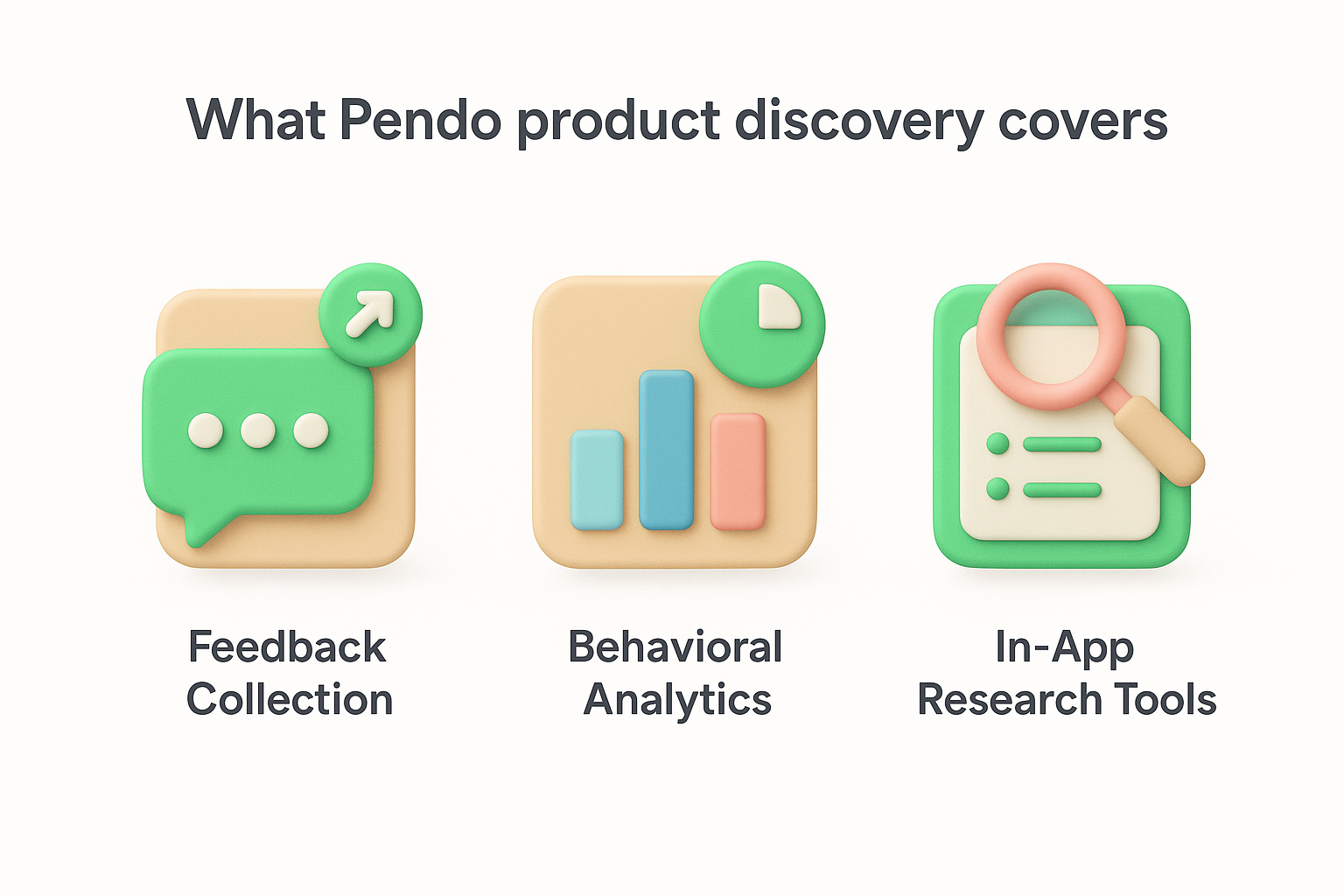
Pendo product discovery is built around three main capabilities: feedback collection, behavioral analytics, and in-app research tools. These work together to give product teams a more complete picture of what users want and how they actually use the product. Rather than relying on disconnected spreadsheets or support tickets, Pendo centralizes this information so teams can move from raw input to prioritized decisions more efficiently.
The core feedback component of the platform is Pendo Listen, which gives users a dedicated portal to submit ideas and feature requests. It uses AI to automatically group similar submissions together, so instead of reading through hundreds of near-identical tickets, you see deduplicated themes with a count of how many users raised the same issue. This makes it much easier to identify patterns without spending hours on manual triage.
The real value of Pendo Listen isn't just collecting feedback - it's reducing the noise so you can focus on what consistently surfaces across your user base.
Product teams can also link feedback directly to accounts and user segments, which means you can filter requests by customer tier, contract size, or product area. A feature request from your ten largest enterprise accounts carries different weight than the same request from ten free-tier users. Pendo Listen surfaces that account-level context rather than treating all feedback as equal.
Pendo lets you deploy NPS polls and targeted surveys directly inside your product without requiring users to navigate elsewhere or respond to an email. Because you trigger these surveys based on specific user behavior, like completing a workflow or reaching a feature for the first time, you capture feedback at the moment when it's most relevant to the user's actual experience.
You can customize the targeting rules so surveys reach the right segment at the right time. A team building a new onboarding flow might survey users who just completed their first setup sequence, rather than pushing a generic prompt to everyone. This kind of precise targeting reduces survey fatigue and consistently improves response rates compared to batch email campaigns.
Discovery is not only about what users say. It's also about what they actually do. Pendo's analytics layer tracks feature adoption, retention patterns, and navigation paths across your product, giving you behavioral evidence to pair with qualitative feedback. When a user requests a feature but analytics show they rarely engage with a similar existing tool, that gap signals a need for deeper investigation before you commit resources.
Teams use this combination of usage data and direct feedback to validate or challenge assumptions before prioritization. Rather than building whatever receives the most votes, you can cross-reference feedback volume with real adoption metrics to find where your development effort will produce the highest return.
Product discovery is the difference between shipping features users actually adopt and shipping features that collect dust in your product backlog. SaaS teams operate under constant pressure to deliver, and without a structured discovery process, development effort gets spent on the loudest request rather than the most impactful one. Building the wrong thing is not just a waste of engineering time. It erodes user trust when the things users repeatedly ask for never appear on your roadmap.
When teams skip discovery, they typically rely on internal assumptions or one-off conversations with a handful of vocal customers. These inputs are not representative of your broader user base, and decisions made from them tend to reflect the preferences of the few rather than the needs of the many. Over time, this pattern leads to bloated products with low feature adoption, where new releases fail to move retention or expansion metrics in any meaningful way.
The teams that consistently build products users love are the ones that invest in discovery before they invest in development.
Structured discovery changes this by replacing guesswork with evidence gathered directly from users at scale. Whether you use pendo product discovery tools or another approach, the goal is the same: build a body of knowledge about what users need before your engineers write a single line of code.
Discovery does not end when you collect feedback. It ends when that feedback informs a concrete prioritization decision your team can act on. That means mapping raw input to user segments, pairing qualitative requests with behavioral usage data, and communicating your decisions back to users so they understand how their input shaped your roadmap.
This feedback loop also drives user engagement and retention. When users see their requests acknowledged and tracked against a public roadmap, they stay more invested in the product and more likely to continue providing useful input over time.
Running pendo product discovery effectively requires more than activating the tools. You need a repeatable process that moves feedback from raw submission to a prioritized roadmap item your team can act on with confidence. The sequence below gives you a practical way to structure that process.
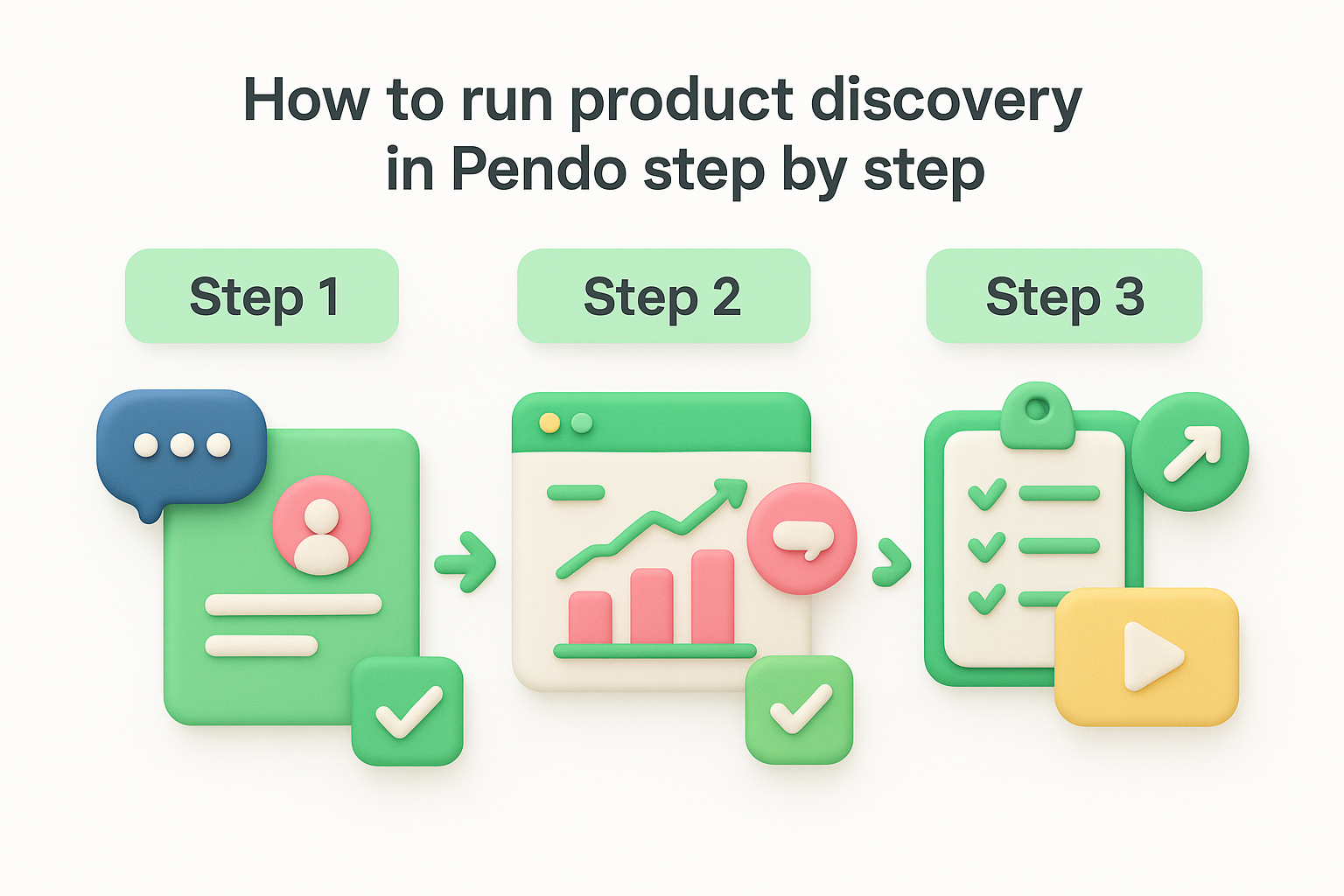
Start by configuring Pendo Listen to collect incoming feature requests and link each submission to the corresponding user account. This account-level connection is what lets you filter feedback by customer segment, contract size, or product area once you move into analysis. Skipping this setup limits your ability to distinguish between high-value requests and noise.
Once your portal is live, let in-app surveys run in parallel with the feedback portal. Trigger NPS polls and targeted questions based on specific user behavior so you capture sentiment while it is still fresh and relevant to what the user just experienced.
After a few weeks of collection, pull your usage analytics alongside your feedback submissions. Look for gaps between what users request and what they actually engage with in your existing product. A feature request that aligns with consistently low adoption in a related area signals a real problem worth investigating, not just a wishlist item.
When behavioral data and user feedback point to the same gap, that is your strongest signal to prioritize.
Use Pendo's filtering tools to rank feedback by account tier and request frequency rather than sorting purely by vote count. Once you finalize your priorities, update your roadmap and notify the users whose input shaped your decisions. Closing this loop keeps submission rates healthy and builds the kind of trust that encourages users to keep engaging with your discovery process over time.
Pendo offers a formal certification program that teaches product teams how to apply structured discovery methods within their workflow. The program is designed for practitioners who want a repeatable framework for validating ideas, not just a technical walkthrough of the platform's features. Completing it signals that you understand both the tools and the underlying principles that make discovery effective at a team level.
The curriculum walks you through the full pendo product discovery cycle, from defining the questions you need to answer before building, to collecting evidence through surveys and feedback, to using behavioral data to pressure-test your conclusions. Each module builds on the previous one, so you finish with a connected workflow rather than a set of isolated skills.
The certification is structured around real product scenarios, which means the skills you build transfer directly to decisions you will face on your actual roadmap.
The program also covers stakeholder communication, including how to present discovery findings to leadership and how to use roadmap transparency to maintain user trust throughout the development cycle. These communication components often get overlooked in purely technical training, but they are where discovery work either gains traction or stalls inside an organization.
The certification is most useful for product managers and product operations leads who are directly responsible for prioritization decisions. If your role involves translating user input into roadmap commitments, the structured framework gives you a defensible process to reference when stakeholders push back on your decisions.
It also works well for team leads onboarding newer product managers, since the curriculum provides a shared vocabulary and process that reduces friction when multiple people contribute to discovery efforts. Completing the program as a team creates alignment on how you collect, evaluate, and act on user feedback before disagreements arise mid-cycle.
Both Pendo and Koala Feedback help product teams collect and act on user input, but they serve different team sizes and discovery needs. Understanding where each platform fits helps you avoid paying for capabilities you will never use, or choosing a tool that falls short when you need it most.
Pendo is a strong fit if your team needs behavioral analytics and feedback collection inside a single platform. The combination of in-app surveys, NPS targeting, and usage tracking gives you quantitative data to complement qualitative input, which is particularly useful for larger teams making decisions on complex products. The pendo product discovery certification also adds real value if you want a structured framework your entire product organization can align around.
Pendo works best when you need deep analytics tied directly to your discovery workflow, and your budget supports an enterprise-level tool.
That said, Pendo's pricing and setup complexity reflect its enterprise focus. If you run a smaller SaaS team and your primary goal is gathering, organizing, and acting on feature requests from users, you may find that much of Pendo's feature set goes unused.
Koala Feedback focuses specifically on feedback collection, feature prioritization, and public roadmap communication, which covers the core of what most SaaS teams need from a discovery process. Users submit ideas through a dedicated portal, vote on existing requests, and follow updates through a transparent public roadmap that keeps them informed at every stage.
Setup takes minutes rather than weeks, and the pricing is built for teams that do not need a full analytics suite to make good prioritization decisions. If your workflow centers on listening to users, ranking requests by demand, and showing users how their input shapes your roadmap, Koala Feedback delivers that without the overhead that comes with a broader platform.
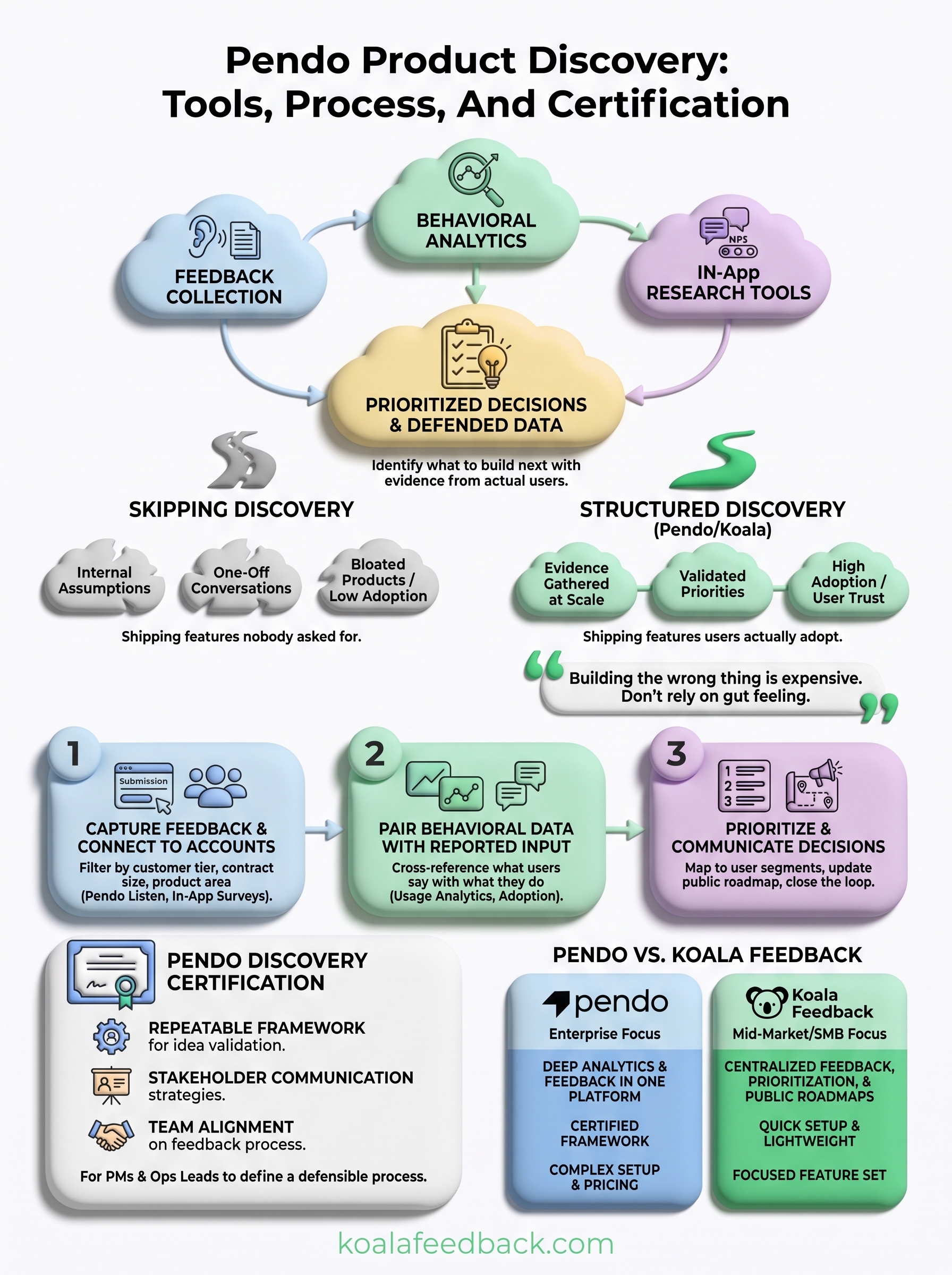
Pendo product discovery gives teams a capable set of tools for combining behavioral analytics with user feedback, and the certification program adds a structured framework for teams that want a repeatable process. If your team already relies on Pendo for analytics and in-app messaging, layering in its discovery features makes sense. But if your primary need is collecting feature requests, ranking them by user demand, and showing users where their input lands on your roadmap, you do not need an enterprise analytics suite to accomplish that.
Start by identifying where your current discovery process breaks down. Are requests scattered across email threads, support tickets, and Slack messages? Are users left wondering whether their feedback ever reached your team? Those gaps point directly to what you need from a tool. If a focused, lightweight approach fits your workflow better, try Koala Feedback to centralize your feedback process and see how it changes the way your team makes prioritization decisions.

Start today and have your feedback portal up and running in minutes.