Your product roadmap is packed with features, but you can't shake the feeling that something's missing. Teams pull in different directions. Stakeholders question priorities. Users wonder where you're headed. The problem isn't execution. You're building without a clear destination.
A product vision solves this. It gives your team a shared picture of what you're working toward and why it matters. With a strong vision, decisions become easier because you have a filter for what fits and what doesn't. Your roadmap stops being a list of random features and starts telling a coherent story.
This guide walks you through building a product vision from scratch. You'll learn what makes a vision actually useful, not just inspirational fluff. We'll cover how to research your context, extract insights from user feedback, define your core message, craft a statement people remember, and get stakeholders aligned. You'll also find real examples and templates you can adapt. By the end, you'll have a framework to create a vision that guides your product decisions and keeps everyone moving in the same direction.
A product vision describes what you want your product to become and the change it will create for users. It's not a feature list or a technical specification. Instead, it paints a picture of the future state you're working toward, typically looking three to five years ahead. When you learn how to develop product vision correctly, you create a tool that filters decisions, not just a motivational poster. The vision answers why your product exists and what impact it should have on the people who use it.
Your mission defines what you do as a company or product. Your strategy outlines how you'll achieve the vision through specific initiatives and resource allocation. The vision sits between these two, describing where you're headed and what success looks like when you get there. Think of the vision as your destination, the mission as your vehicle, and the strategy as your route. Without a clear vision, your strategy becomes a random collection of tactics that may or may not lead anywhere meaningful.
Three elements make a product vision work in practice. First, you need a target outcome that describes the change your product creates for users or the market. Second, you need a timeframe that makes the vision feel real without boxing you into specific features. Third, you need clear beneficiaries so everyone knows who wins when you succeed. These components give your vision enough structure to guide decisions while leaving room for the strategy to adapt as conditions change.

A vision without these three elements becomes either too vague to guide decisions or too specific to survive contact with reality.
Most failed visions lack one of these pieces. They describe features instead of outcomes, skip the timeframe entirely, or stay so abstract that no one can picture the actual result. When you combine all three components, you create a north star that teams can reference when priorities clash or new opportunities emerge.
Before you can define where your product should go, you need to understand where it stands today. Your product context includes your current market position, the trends shaping your industry, and how competitors address similar problems. When you learn how to develop product vision without this foundation, you risk building a vision disconnected from reality. Start by gathering facts about your product's present state and the forces that will shape its future.
Look at where your product sits in relation to customer needs and expectations. Document your current user base, their primary use cases, and what they value most about your product. Check your analytics to identify which features drive adoption and which ones users ignore. If you serve enterprise customers, note how procurement teams categorize your product when they evaluate it. This baseline helps you spot gaps between what you offer today and what a compelling future could look like.
List three to five major trends that will impact your product category over the next few years. These might include technological shifts, regulatory changes, evolving customer behaviors, or new business models. Focus on trends with staying power, not temporary fads. For example, if you build project management software, consider how distributed teams and asynchronous work patterns affect collaboration needs. Write down how each trend creates opportunities for your product or threatens its relevance. This step prevents your vision from becoming outdated before you finish building it.
Trends with real impact reshape user expectations, not just add new buzzwords to marketing decks.
Study how competitors position themselves and what visions they communicate publicly. Read their about pages, product announcements, and founder interviews. Note the language they use to describe their aspirations. Then identify what makes your approach different in terms of target users, problem framing, or solution philosophy. You don't need a formal competitive analysis document. A simple table comparing positioning statements works fine. This exercise helps you articulate a vision that stands apart while acknowledging the reality of your market.
| Competitor | Their Vision Focus | Gap You Can Fill |
|---|---|---|
| Competitor A | Enterprise scale | Better usability for small teams |
| Competitor B | Feature breadth | Depth in specific workflows |
| Competitor C | Low cost | Premium experience worth paying for |
Your users already told you what matters to them. The challenge is extracting meaningful patterns from scattered feedback and behavioral data. When you learn how to develop product vision with real user insight, you ground your aspirations in actual needs instead of assumptions. This step requires systematically reviewing what users say and matching those words to what they actually do in your product. The gap between stated needs and observed behavior often reveals the most valuable opportunities.
Start by collecting feedback from every channel where users share opinions. Pull comments from support tickets, feature request forms, app store reviews, social media mentions, and sales call notes. If you use a feedback management tool, export all submissions from the past year. Create a spreadsheet with columns for feedback text, user segment, date, and source. Read through at least 100 feedback items to get a sense of recurring themes. Look for requests that appear in multiple forms from different user types. A feature request mentioned once might be noise, but the same core need expressed ten different ways signals something worth addressing in your vision.
Group similar feedback into categories using simple labels like "collaboration," "reporting," or "mobile access." Count how many times each category appears and note which user segments care most about each theme. This quantitative view helps you spot which problems affect the most people versus which ones just attract vocal minorities.
Open your analytics platform and identify your most-used features by tracking session frequency and time spent. Then find features with high abandonment rates or low adoption despite prominent placement. These patterns reveal what users value and where your product falls short. For example, if users spend most of their time in a basic feature but rarely touch advanced capabilities, your vision might focus on depth rather than breadth. Export a report showing feature usage by customer segment to spot differences between how enterprise users and small teams interact with your product.
Usage patterns trump stated preferences because they show what users actually need when deadlines hit and budgets tighten.
Schedule five to ten customer interviews with users who represent different segments and experience levels. Ask them about their biggest challenges, not about features they want. Frame questions around outcomes: "What would success look like six months from now?" or "What problem keeps you up at night?" Record these conversations and transcribe them. Look for emotional language that signals frustration or excitement. A customer who says "I waste hours every week on this" gives you stronger signal than one who suggests "it would be nice if." Direct conversations surface context that feedback forms and analytics miss.
You've gathered context and user insights. Now you distill that information into the core message that will guide your product for years. This step requires you to make hard choices about what matters most and what you're willing to leave behind. When you learn how to develop product vision at this stage, you translate research into a clear statement of intent. The goal isn't perfection but clarity. You need to articulate the transformation your product will create, how it differs from alternatives, and the boundaries that keep you focused.
Start by answering this question: What will be different for users when your product succeeds? Write three to five sentences describing the before and after state. Focus on outcomes, not features. For example, instead of "users will have a dashboard," write "teams will spot problems before they become crises." Look at the feedback patterns and usage data you collected earlier. Which transformation addresses the most critical pain while aligning with market trends you identified? Your answer becomes the foundation of your vision core.
Test your transformation statement by asking if it describes a meaningful change in user behavior or results. Weak transformations talk about what your product has. Strong transformations talk about what users achieve. A project management tool might transform "chaotic workflows into predictable delivery." A feedback platform might transform "scattered suggestions into prioritized roadmaps."
Define what makes your approach unique compared to how competitors address the same transformation. You don't need a novel technology or revolutionary business model. You need a clear stance on what trade-offs you'll make differently than others in your space. Maybe you prioritize simplicity over features, speed over customization, or depth over breadth. Write one paragraph explaining your angle and why it matters to your target users. This differentiation filters future decisions by establishing which opportunities fit your vision and which ones don't.
Your differentiation angle should make some potential customers love you and others look elsewhere, not try to please everyone equally.
Set a realistic timeframe for achieving your vision, typically three to five years. This prevents your vision from becoming either too abstract or too tactical. Document the scope by listing what your vision includes and excludes. For instance, if you build team collaboration software, your scope might include real-time communication but exclude project accounting. Create a simple boundary table:
| In Scope | Out of Scope | Why |
|---|---|---|
| Async team updates | Personal productivity | Focus on team collaboration |
| Integration with work tools | Consumer social features | Serve workplace needs |
| Mobile and desktop access | IoT device support | Match where work happens |
These boundaries give your team permission to say no to opportunities that distract from the core transformation. They also help stakeholders understand your strategic choices when you present the vision.
Your core message needs to become a statement people can remember and repeat without checking notes. This step takes the transformation, differentiation, and scope you defined and compresses them into a single compelling sentence or short paragraph. When you learn how to develop product vision statements that stick, you create a reference point your team can use daily. The statement should capture the essence of your vision without requiring explanation. You're not writing marketing copy here. You're crafting the sentence that will guide product decisions for the next several years.
Start by creating five to ten different versions of your vision statement using the core elements you defined. Each version should take a different angle on the same transformation. Try starting some with "We will," others with "Our product enables," and a few that simply describe the future state. Vary the length from one sentence to three sentences. Write down every version without editing yourself. This generates options and prevents you from getting stuck on your first attempt.
Look at your list and identify which versions feel authentic to your product's personality and market position. Cross out any that sound generic enough to describe a competitor. Keep the three statements that best capture your unique transformation and differentiation. Here are example formats you can adapt:
Format 1 (Outcome-focused): [User type] will [achieve outcome] without [current obstacle]
Format 2 (Transformation-focused): We're building a world where [current pain] becomes [desired state]
Format 3 (Differentiation-focused): Unlike [alternative], we help [users] [transformation] through [unique approach]
Take your top three statements and read them to someone unfamiliar with your product. Ask them to repeat back what they heard in their own words. A strong vision statement survives this test because the listener can grasp the core idea even if they forget exact wording. If they look confused or ask clarifying questions, your statement carries too much jargon or assumes too much context. Rewrite using simpler language and concrete terms instead of abstract concepts.
A vision statement works when someone outside your team can explain your product's purpose after hearing it once.
Check if each statement passes the time test by imagining whether it still makes sense three years from now. Statements tied to specific technologies or temporary market conditions age poorly. Your vision should describe an enduring transformation that remains relevant as tactics and features evolve.
Choose your strongest statement and refine it word by word. Replace passive constructions with active verbs. Cut any word that doesn't add meaning. Change abstract terms to concrete ones. For example, "facilitate collaboration" becomes "help teams work together." Make sure the statement uses present or future tense to create forward momentum. Remove qualifiers like "try to" or "aim to" that weaken your commitment. Read it aloud to check rhythm and flow. Your final statement should feel both ambitious and achievable when you say it to investors, customers, or new hires.
Your vision statement means nothing if stakeholders ignore it or undermine it through competing priorities. This step focuses on getting genuine buy-in from the people who control resources, set strategy, and influence your product's direction. When you learn how to develop product vision alignment, you transform a document into a shared commitment that shapes decisions. You need executives, engineering leads, sales leaders, and marketing teams to understand the vision and support it actively. This requires more than sending an email with your vision statement attached.
Schedule a dedicated meeting with key stakeholders to present your vision, not a quick mention in an existing status review. Start by sharing the research that led to your vision, including the feedback patterns, usage data, and market trends you identified. Walk through the transformation you're targeting and why it matters to users and the business. Show stakeholders the competitive landscape and explain your differentiation angle. This context helps them understand that your vision comes from evidence and strategy, not personal preference or guesswork.
Prepare a simple one-page document that includes your vision statement, the three to five year timeframe, and what falls inside and outside your scope. Add bullet points summarizing the key insights that shaped your thinking. Distribute this document at the start of your meeting so stakeholders can follow along. Use concrete examples from real customer feedback to illustrate the problems your vision addresses. When you ground your vision in actual user pain and market reality, stakeholders see it as credible rather than aspirational fantasy.
Anticipate objections before stakeholders raise them. Common concerns include resource requirements, conflicts with existing priorities, risks of narrowing focus too much, or doubts about market demand. Address each concern directly by explaining how your vision accounts for these factors. For example, if engineering worries about technical feasibility, share how your timeframe allows for iterative development rather than requiring everything at once. If sales fears losing deals, explain how clear differentiation actually helps close customers who value your unique approach.
Stakeholder resistance usually stems from unstated fears about how the vision affects their domain, not disagreement with the vision itself.
Ask stakeholders to voice concerns openly during your presentation. Write down each concern and commit to following up with specific answers. This shows you take their perspective seriously and prevents quiet resistance from building later. Some concerns might reveal blind spots in your vision that you need to address before finalizing it.
Getting stakeholders to nod along in a meeting doesn't create alignment. You need explicit commitment to use the vision when making decisions. Ask each stakeholder how the vision affects their team's priorities and what changes they'll make as a result. Document these commitments in your meeting notes. For example, if your marketing leader commits to repositioning messaging around your differentiation angle, write that down with a target date. If your engineering lead agrees to prioritize capabilities that support the core transformation, record that commitment too.
Create a simple stakeholder commitment table that you can reference later:
| Stakeholder | Their Commitment | Target Date |
|---|---|---|
| VP Engineering | Align Q1 roadmap with vision | Jan 15 |
| Head of Sales | Update pitch deck | Jan 30 |
| Marketing Lead | Revise positioning | Feb 15 |
Schedule a follow-up meeting thirty days later to review progress on these commitments. This accountability loop ensures your vision actually shapes behavior instead of collecting dust in a slide deck. When stakeholders know you'll check back, they take their commitments seriously.
You don't need to start from scratch when you learn how to develop product vision statements. The following templates give you a structured starting point that you can customize based on your product's stage and market position. Each template includes placeholders you replace with your specific transformation, users, and differentiation. Use these frameworks to speed up your writing process while maintaining the clarity and specificity your vision needs.
When your product is new or pre-launch, your vision needs to establish the problem space and hint at your unique approach without committing to specific features. This template works best for products still validating their market fit.
Template: For [target user segment] who [struggle with current situation], [product name] is a [category] that [enables transformation]. Unlike [current alternatives], we [differentiation through approach or philosophy].
Example using template: For product teams who struggle to understand which features matter most, FeedbackHub is a prioritization platform that turns scattered user opinions into clear roadmap decisions. Unlike generic survey tools, we connect feedback directly to your development workflow.
Established products need vision statements that acknowledge your current position while pointing toward evolution. This template balances continuity with ambition, showing stakeholders where you're headed without abandoning what works today.
Template: We're evolving [product name] from [current state] into [future state] so that [target users] can [achieve outcome] that [current approach] makes difficult or impossible.
Example using template: We're evolving TaskFlow from a basic project tracker into an intelligent work orchestrator so that distributed teams can maintain alignment across time zones without endless meetings that synchronous tools require.
Templates accelerate your first draft but your final statement must reflect your product's unique context, not just fill-in-the-blank words.
Study how established products frame their visions to understand what makes statements memorable and actionable. Netflix states "we want to entertain the world," which sets an ambitious scope while remaining focused on entertainment rather than trying to solve every human need. Airbnb's vision of "a world where anyone can belong anywhere" describes a transformation in human connection beyond just booking accommodations. Spotify aims to "unlock the potential of human creativity" which positions their product as an enabler rather than just a consumption platform.
Notice these examples avoid mentioning specific features or technologies. They describe outcomes and transformations that remain relevant even as tactics change. When you adapt these patterns, replace their transformation with yours while maintaining the same level of clarity and forward momentum.
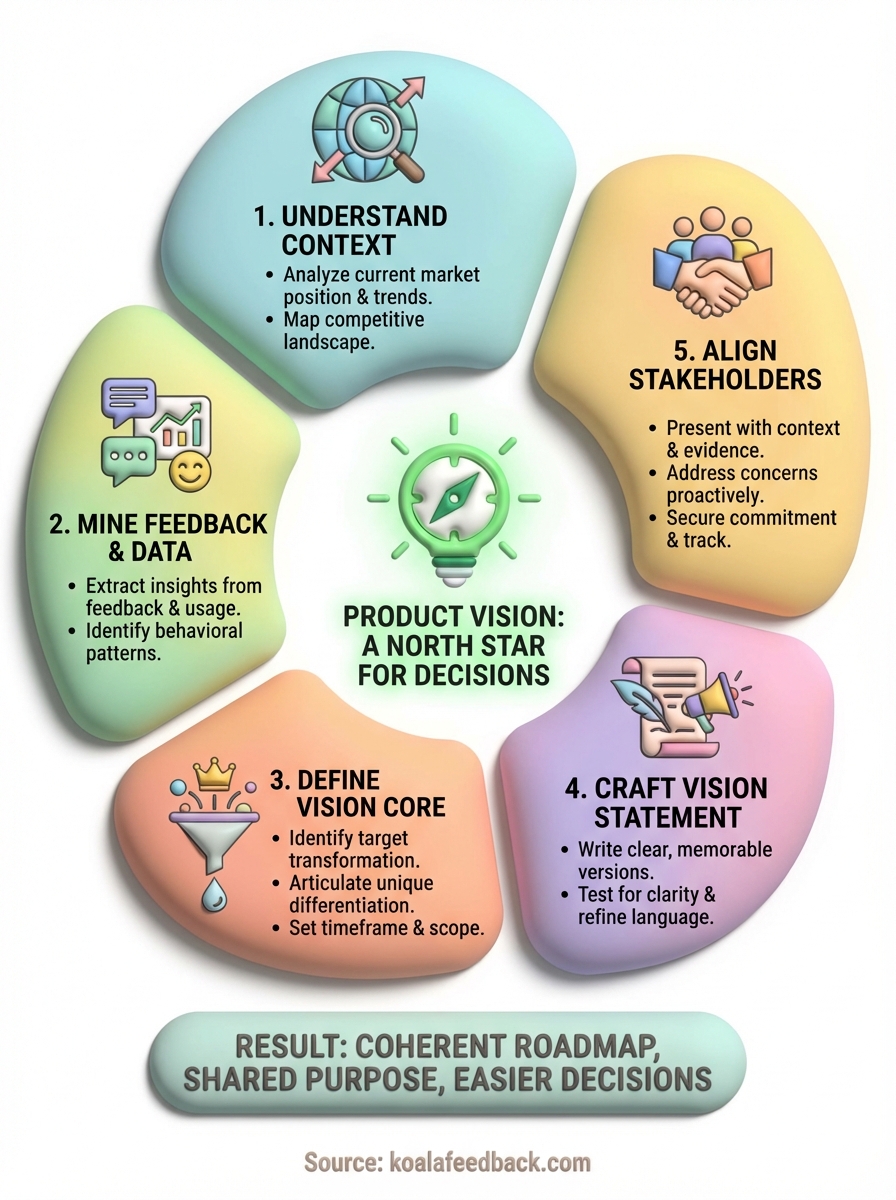
You now have a complete framework for building a product vision that guides real decisions. The process moves from understanding your context and mining user feedback to defining your core transformation and aligning stakeholders. Each step builds on the last to create a vision grounded in evidence, not wishful thinking. Your vision statement becomes the filter that helps you choose which opportunities to pursue and which ones to decline.
When you learn how to develop product vision using this approach, you create clarity that compounds over time. Every roadmap discussion, feature debate, and resource allocation decision becomes easier because your team can reference the vision. The vision doesn't eliminate tough choices, but it gives you a consistent framework for making them.
Your vision only works if you feed it with continuous user insight. Koala Feedback centralizes feedback collection and prioritization so you can spot the patterns that should shape your vision and validate whether you're moving in the right direction. Start building your vision today with the templates and steps you learned here.

Start today and have your feedback portal up and running in minutes.