You built a product vision that excites you. But when you share it with executives, you get blank stares. When you present it to your team, they nod along but still ask what they should build next. The vision sits in a slide deck nobody references. Your stakeholders drift back to feature requests and immediate fires because they never connected with where you want to take the product.
The problem is rarely the vision itself. You need a repeatable way to translate your product vision into something each audience can understand and act on. This means structuring your message differently for executives who care about business impact versus engineers who need technical clarity versus customers who want to know what's coming.
This guide shows you how to communicate product vision that actually sticks. You'll learn why clear vision communication changes outcomes, how to pressure test your vision before you share it, which frameworks make your story easier to follow, how to adapt your message for different stakeholders, and real examples you can use as templates.
A clear product vision acts as your decision filter. When your team understands where the product is heading, they make better daily choices without waiting for your approval. Developers pick the right technical approach. Designers create interfaces that support future features. Customer success teams set accurate expectations. Everyone moves faster because they know what matters and what doesn't.

Your engineers face dozens of micro-decisions every day. Should they build this feature to handle ten users or ten thousand? Should they use technology that supports your five-year vision or solve today's problem with a shortcut? Without clear vision communication, they guess. They ask more questions. They build the wrong thing and need to rebuild it later. Teams that understand your product vision ship features that compound instead of creating technical debt you'll regret.
Stakeholders approve budgets and headcount for initiatives they understand. When you walk into a quarterly planning meeting with a vague vision, executives default to maintaining the status quo or funding whoever makes the strongest emotional appeal. Communicating product vision with concrete outcomes and measurable milestones gives decision-makers the confidence to invest. They see how your vision connects to revenue, retention, or market position.
A product vision you can't explain clearly is a product vision that won't get built.
You can't communicate a product vision effectively until you define it clearly for yourself first. Most product managers skip this step and jump straight to creating presentations. They think they know their vision but can't articulate it without rambling. Before you schedule stakeholder meetings, write down your vision and test whether it passes basic scrutiny. This preparation makes everything else easier.
Your vision statement needs to fit in one sentence. Not a paragraph. Not a bulleted list. One sentence that answers what you're building, who it's for, and why it matters. Use this formula: "We help [target audience] achieve [specific outcome] by [unique approach]." Strip out marketing fluff and vague words like "innovative" or "leading." If you can't explain your vision in one sentence, you don't understand it well enough yet to communicate it to others.
Test your statement on someone outside your product team. Ask them to repeat what you said in their own words. If they can't, your vision statement is too complex or too abstract.
Your vision statement needs to survive three tests before you share it widely. First, does it pass the "so what" test? If someone responds with "so what," your vision doesn't connect to real business value or customer pain. Second, does it create clear boundaries? A good vision tells you what not to build as much as what to build. Third, can you measure progress toward it? You need concrete metrics that show whether you're moving closer to your vision or drifting away from it.
A product vision that survives these pressure tests becomes easier to defend when stakeholders challenge your decisions.
Write down your answers to these questions. You'll reference them when executives or team members question your direction later. Communicating product vision becomes exponentially easier when you've already stress-tested your thinking and prepared for obvious objections.
Frameworks give you a repeatable structure for communicating product vision across different contexts. Instead of reinventing your message every time, you use tested patterns that make complex ideas digestible. The best frameworks force you to eliminate noise and focus on what matters. They help your audience follow your logic without getting lost in details.
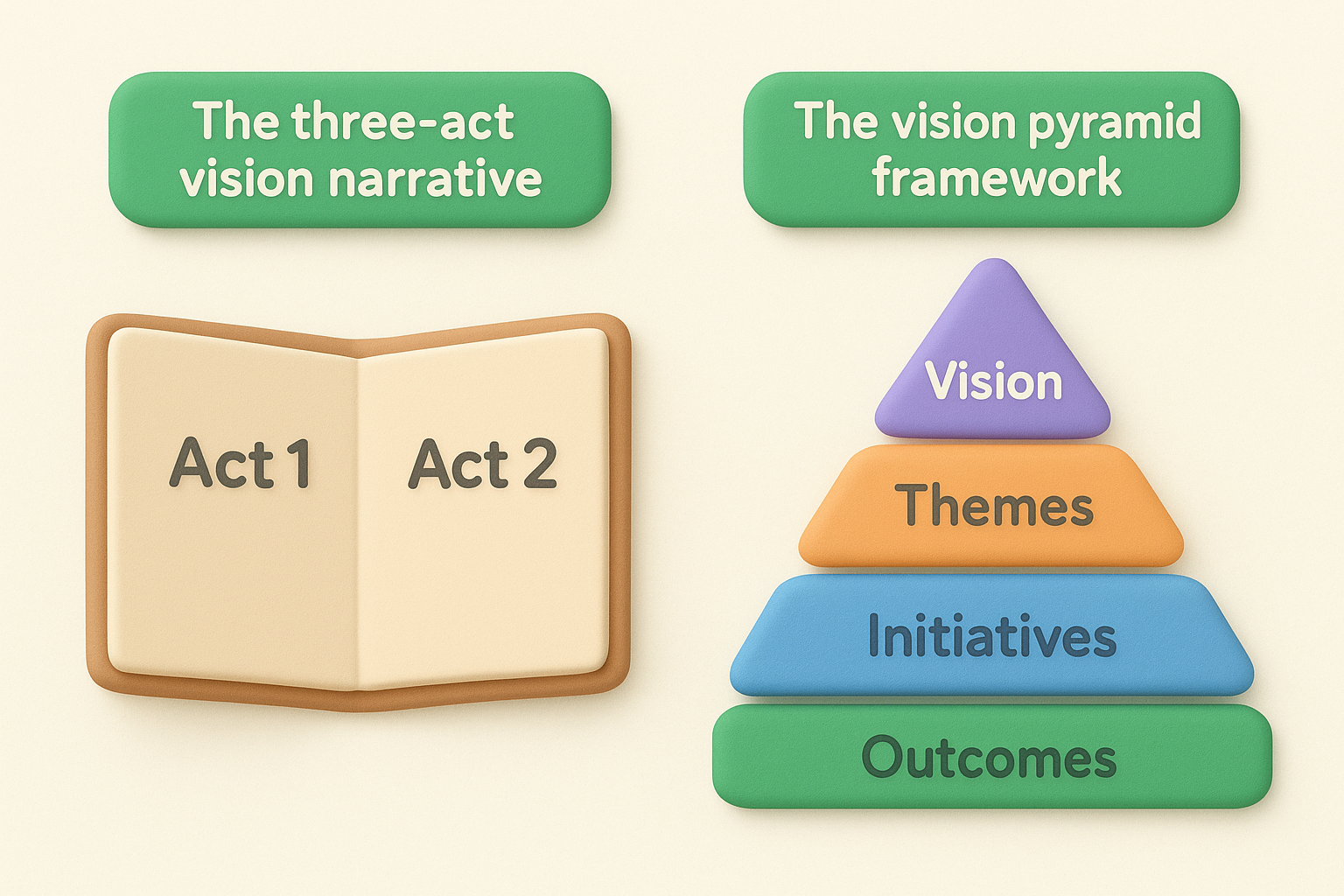
Structure your vision as a three-part story that moves from present reality to future state. Start with the problem your customers face today and why current solutions fall short. Move to your vision of how things should work differently and what becomes possible when you solve the problem correctly. End with concrete proof points that show your approach works or will work. This narrative structure matches how people naturally process information and makes your vision memorable.
Use this template to draft your story:
Act 1 (The problem): "Right now, [target audience] struggles with [specific pain point] because [root cause]."
Act 2 (The vision): "We're building a product where [desired future state] by [unique approach]."
Act 3 (The proof): "We know this works because [early evidence or market signal]."
A story-based approach to communicating product vision makes abstract concepts concrete and helps stakeholders remember your message weeks later.
Your vision sits at the top of a pyramid with supporting layers underneath. The vision statement forms the peak. Below that, you place strategic themes (the three to five big areas you'll focus on). The next layer contains specific initiatives that support each theme. The bottom layer shows measurable outcomes you expect from each initiative. This pyramid lets you zoom in and out depending on your audience. Executives see the top two layers. Your team needs all four layers to make daily decisions.
Different stakeholders need different versions of your product vision. Executives care about business impact and competitive positioning. Your product team needs technical clarity and priorities. Customers want to understand what changes and when. The mistake most product managers make is using the same presentation for every audience. Communicating product vision effectively means adapting your message while keeping the core vision consistent.
Executives allocate resources based on expected returns. Skip the product details and focus on market opportunity, competitive advantage, and financial impact. Open with the business problem you're solving and the revenue or cost savings your vision creates. Use metrics they already track like customer acquisition cost, lifetime value, or market share. Connect each vision element to a specific business outcome within a timeframe they care about (usually quarterly or annual).
Structure your executive communication this way:
Your team needs to understand how their work connects to the bigger picture. Start with the customer problem in concrete terms they can visualize. Walk through the technical approach at a high level so engineers see architectural implications. Break the vision into specific milestones with clear success metrics. Give your team permission to say no to requests that don't align with the vision.
Hold regular vision check-ins where team members challenge assumptions and suggest adjustments. Engineers often spot technical constraints you missed. Designers identify user experience gaps. These sessions improve your vision and increase team ownership because they helped shape it.
When your team understands both the vision and their role in achieving it, they make better decisions without waiting for approval.
You don't need to start from scratch when communicating product vision. Use these proven templates as starting points and adapt them to your product and audience. Each template below has worked for real product teams and gives you structure you can fill in with your specific details.
Start with these one-sentence formats to crystallize your vision before you build presentations. Pick the template that best matches your product type and fill in the brackets with your specific information.
For B2B products: "We help [specific role] at [company type] achieve [measurable outcome] by [unique capability] so they can [business impact]."
For consumer products: "We enable [target user] to [desired action] without [current friction] by [differentiated approach]."
For platform products: "We provide [user type] the ability to [core action] through [technology approach] that [competitive advantage]."
These templates force you to be specific about who you serve, what you deliver, and why it matters.
Use this slide structure when presenting your vision to executives or investors. Each section builds on the previous one to create a logical flow.
Slide 1: The problem
Slide 2: Our vision
Slide 3: Strategic approach
Slide 4: Early proof
Adapt this framework by expanding sections your audience cares most about. Executives need more detail on business metrics. Technical stakeholders want deeper explanation of your approach.
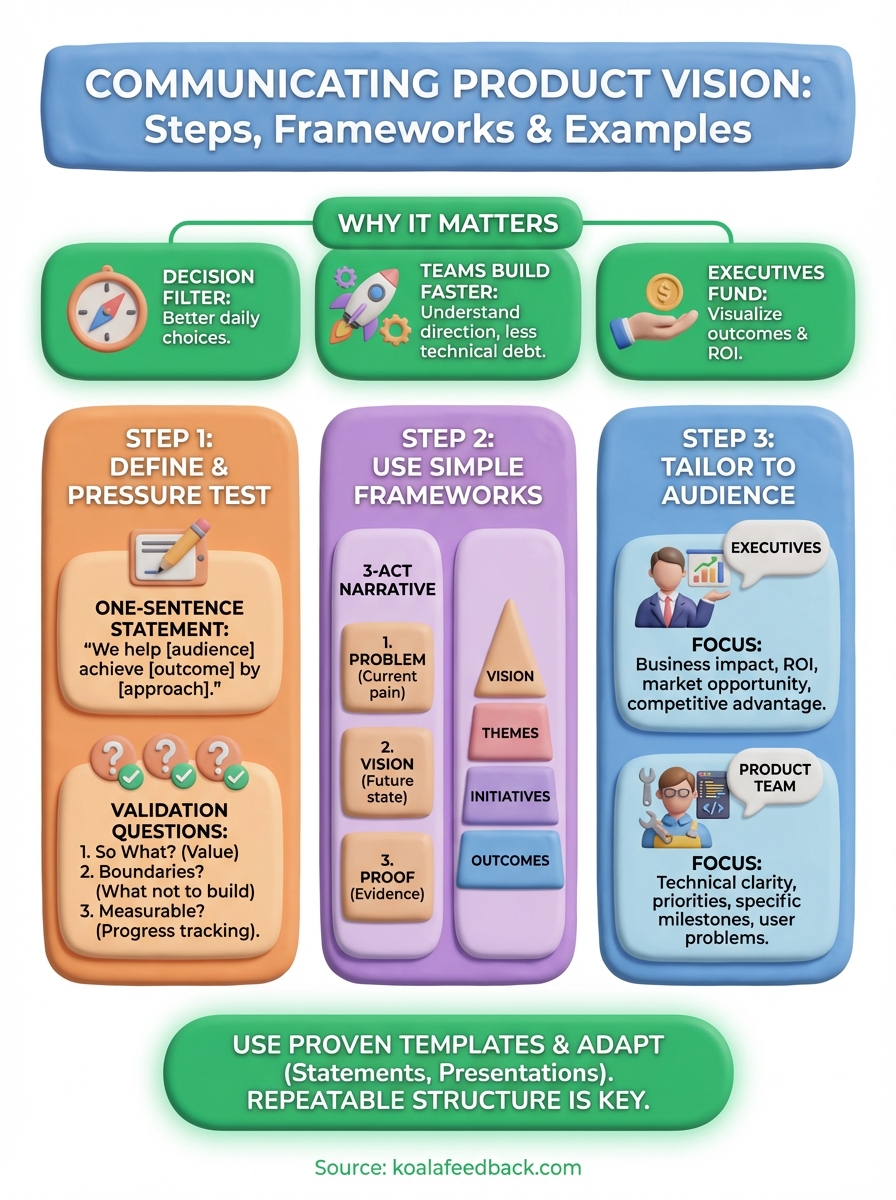
Communicating product vision effectively requires preparation, structure, and adaptation. You learned how to pressure test your vision statement, use frameworks like the three-act narrative and vision pyramid, and tailor your message for different audiences. These steps transform vague ideas into clear direction that stakeholders can support and teams can execute.
Start by writing your one-sentence vision statement this week. Test it against the validation questions until it survives scrutiny. Build your presentation using the templates provided and schedule conversations with key stakeholders. Each conversation gives you feedback to refine how you communicate.
Track your feedback and feature requests in a centralized system so your vision connects to real user needs. Koala Feedback helps you collect customer input, prioritize requests that align with your vision, and share your roadmap transparently. You'll make better decisions when you can see which features your users actually want.

Start today and have your feedback portal up and running in minutes.