You're building features nobody uses. Your team debates endlessly about what to build next, making decisions based on hunches rather than data. Development cycles stretch longer than they should because critical information lives scattered across email threads, Slack channels, and random spreadsheets. Your developers waste hours building the wrong things while your customers wonder if anyone is actually listening. This disorganized approach drains your budget, frustrates your team, and damages trust with the users who matter most. The benefits of product lifecycle management address every one of these pain points.
This article breaks down six specific advantages that PLM delivers for SaaS companies. You'll learn how it transforms your feature prioritization with real user data, cuts your time to market by breaking down silos, and stops you from wasting resources on features that collect dust. We'll show you how PLM creates a single source of truth for product decisions, gets your entire team working toward the same goals, and builds lasting relationships with customers through transparency and active engagement.
Your product roadmap decisions carry real consequences. Build the wrong feature and you've burned weeks of development time, stretched your budget thin, and disappointed the users who actually needed something else. Most SaaS teams make these choices based on gut feelings or whoever argued loudest in the last meeting. PLM replaces this guesswork with a framework that shows you exactly what your users want and need.
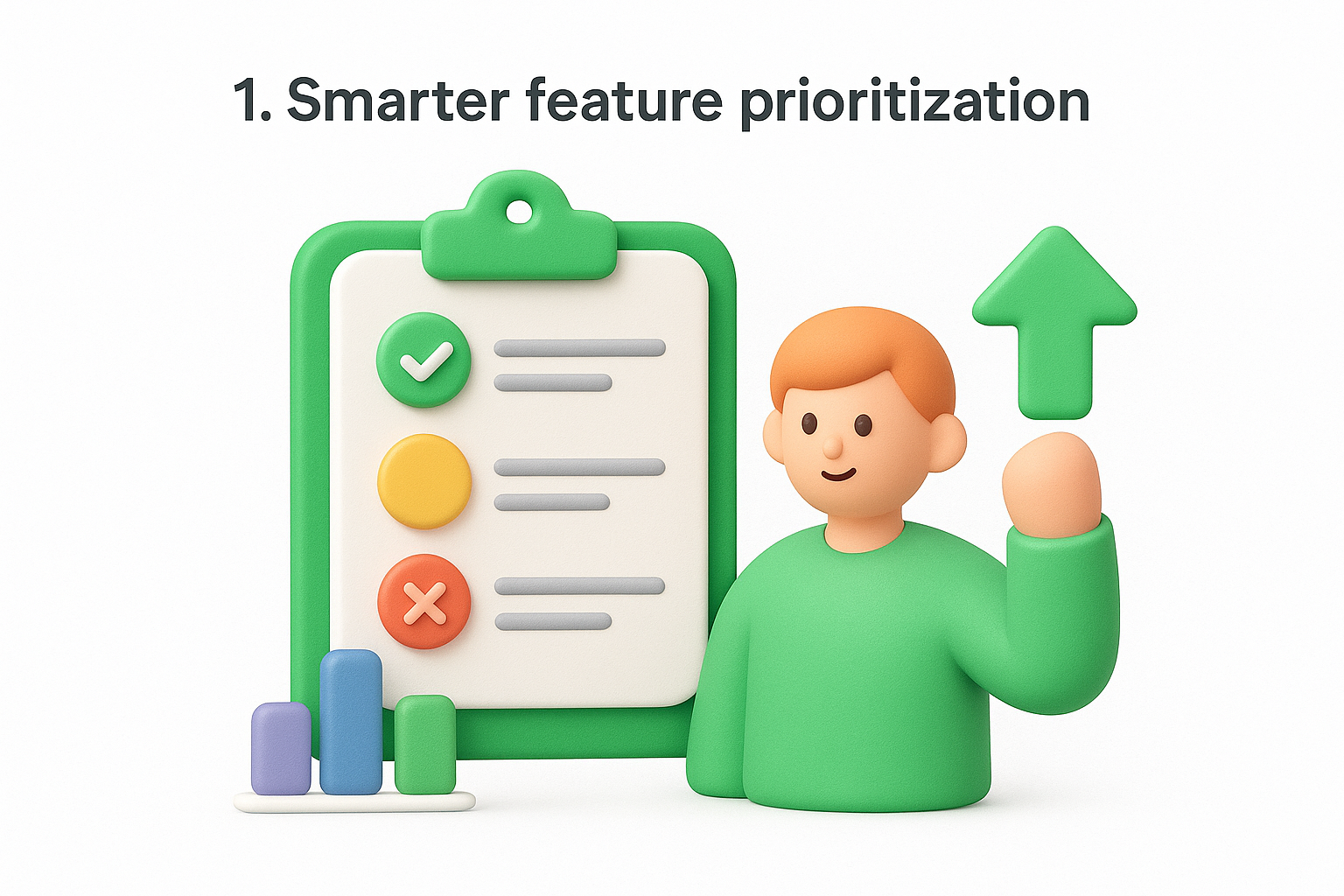
You face this scenario constantly: your sales team insists one feature will close deals, your CEO has a pet project they've been pushing for months, and your developers want to tackle the technical debt they find most annoying. Meanwhile, your actual users are struggling with problems none of these stakeholders have mentioned. Without a systematic way to capture and evaluate feedback, you default to the loudest voice or the highest-paid person's opinion. Your roadmap becomes a collection of disconnected bets rather than a strategic plan. This approach explains why so many SaaS products ship features that generate zero adoption and miss the improvements users would have actually paid for.
PLM gives you quantifiable signals about what matters. You see which feature requests attract the most votes, which pain points appear repeatedly across different customer segments, and which improvements align with your strategic goals. This visibility transforms roadmap planning from a political exercise into a data-informed process. You can show your team exactly why you're prioritizing feature A over feature B, backed by real numbers about user demand and business impact.
When you replace opinions with evidence, your product decisions become defensible and your team stops arguing about hunches.
The benefits of product lifecycle management show up immediately in your prioritization meetings. Instead of debating hypotheticals, you discuss actual user needs supported by voting data, usage patterns, and feedback volume. Your roadmap reflects what your market wants, not what your internal stakeholders think they want.
Your competitors ship faster because they've removed the organizational friction that slows you down. Every day your release cycle drags on, you lose potential revenue and give rivals more time to capture your market share. PLM collapses the timeline between identifying a user need and delivering the solution by creating direct pathways between feedback collection, prioritization, and development execution.
Your product team makes decisions in isolation from customer success. Engineering builds features without understanding the business context behind them. Sales promises capabilities that don't exist on your roadmap yet. This fragmentation creates delays at every handoff point because teams spend hours hunting for information that should be immediately accessible. Critical details get lost in translation, forcing developers to stop mid-sprint and track down stakeholders for clarification. Each miscommunication extends your delivery timeline and increases the risk of shipping something that misses the mark entirely.
PLM connects everyone to the same information at the same time. Your developers see the original user request, understand the business value, and know exactly who to contact if questions arise. Customer success teams track feature progress in real time and can give users accurate timelines without bothering product managers for updates.
When your entire organization operates from a unified view of what needs building and why, you eliminate the delays that come from information gaps and miscommunication.
This transparency is one of the benefits of product lifecycle management that directly impacts your bottom line.
You're spending developer salaries on features that generate zero business value. Each unused feature represents wasted time, squandered budget, and opportunity cost from the valuable improvements you didn't build instead. PLM prevents this waste by validating user demand before you commit resources to development, ensuring your team only builds what users will actually adopt and use.
Teams ship features based on assumptions rather than evidence. Someone thinks a capability would be nice to have, your competitor launched something similar, or an executive attended a conference and got excited about a trend. You greenlight the project, spend weeks building it, and then watch adoption metrics flat line after launch. Users don't need what you built, or they need it solved differently. This pattern repeats because you lack a reliable mechanism to test demand before investing development resources. Your product becomes bloated with features nobody asked for while critical improvements remain stuck in the backlog.
PLM shows you request volume and user engagement before you write a single line of code. You see how many users want a feature, which customer segments are asking for it, and how intensely they need it based on voting patterns and comment activity. This validation process is one of the core benefits of product lifecycle management for resource allocation.
When you only build features with proven demand, you maximize the return on every development dollar and keep your product focused on solving real problems.
Information scattered across multiple systems creates chaos. Your product decisions depend on data buried in support tickets, feature requests living in spreadsheets, roadmap updates hiding in slides, and user feedback trapped in email threads. Finding what you need requires searching through platforms, asking around, and hoping someone remembers where that critical conversation happened. PLM consolidates all product-related information into one accessible location, eliminating the time you waste hunting for context and reducing the errors that come from working with incomplete information.
Every platform your team uses becomes another silo where important details get trapped. Customer success logs feedback in your CRM, users submit ideas through email, developers track bugs in Jira, and product managers maintain separate roadmaps in presentation software. Nobody has a complete picture of user needs, feature status, or development priorities because the relevant information exists across disconnected tools. Developers build features without seeing the original user requests that inspired them. Support teams can't tell customers when their requested improvements will ship because that timeline lives in a system they don't access.
PLM creates one destination for everything related to product development. User feedback, feature votes, roadmap status, and development progress all live in the same platform where everyone can access them. Questions get answered instantly because the information exists in a searchable, organized system rather than someone's inbox. This consolidation represents one of the key benefits of product lifecycle management for operational efficiency.
When your entire team works from the same dataset, you eliminate confusion and make better decisions faster.
Your product, engineering, and customer success teams make conflicting decisions because they operate from different information sets and pursue separate goals. Product commits to features without checking engineering capacity. Engineering builds solutions without understanding the customer context behind requests. Customer success promises timelines they can't deliver because they don't know what's actually in development. This misalignment burns your budget through rework, creates tension between departments, and ultimately damages the user experience when your company speaks with multiple voices.
Cross-functional collaboration fails when teams can't see what others are doing or why. Your developers finish a feature that customer success doesn't know how to position because they weren't involved in planning discussions. Product managers schedule releases without confirming whether engineering has the bandwidth to deliver on time. Sales sells capabilities based on outdated roadmap information and creates commitments your team can't meet. These disconnects happen because each department maintains its own systems, schedules, and priorities. Information sharing depends on someone remembering to send an update or scheduling yet another status meeting that pulls people away from actual work.
PLM gives every department real-time access to the same product information. Your customer success team sees exactly what's in development and can set accurate expectations with users. Engineers understand which features matter most to your business and why. Sales references your public roadmap to show prospects what's coming without creating false promises. This alignment is one of the most immediate benefits of product lifecycle management for organizational efficiency.
When everyone works from the same roadmap and understands the reasoning behind priorities, your teams stop duplicating effort and start reinforcing each other's work.
You lose customers silently because they feel ignored. Users submit feedback, watch nothing happen, and eventually leave for competitors who make them feel heard. This churn costs you recurring revenue and acquisition costs while damaging your reputation through negative word of mouth. PLM transforms this dynamic by creating visible channels for user engagement and demonstrating that their input shapes your product direction, turning passive subscribers into invested stakeholders who stick around.
Users stop renewing when they believe their needs don't matter to you. They submit feature requests that disappear into a black hole, ask for improvements that never materialize, and gradually lose confidence in your product's ability to solve their evolving problems. Without visibility into your development process, they assume you're either ignoring their feedback or building for different customers entirely. This perception drives them to explore alternatives, and by the time you notice their engagement dropping, they've already mentally checked out. Customer success teams can't intervene effectively because they lack insight into which users feel neglected and why.
PLM lets users see their feedback acknowledged and tracked. They watch requests move from submitted to planned to in progress, giving them confidence that you're listening and acting on their input. This visibility represents one of the tangible benefits of product lifecycle management for reducing churn.
When users see their ideas influencing your roadmap, they become partners in your product's evolution rather than passive consumers evaluating whether to switch providers.
Users who feel heard renew subscriptions, recommend your product, and provide valuable feedback that makes your offering stronger over time.
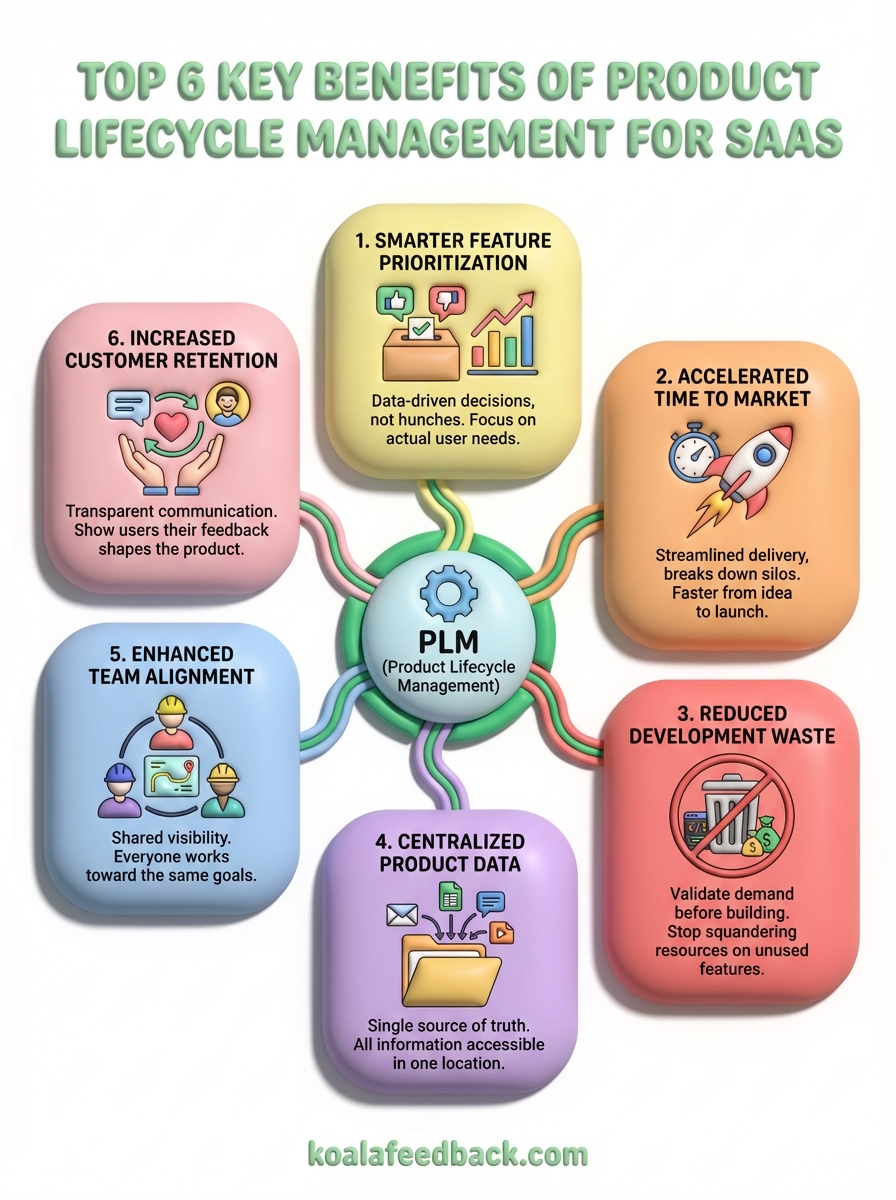
The benefits of product lifecycle management extend far beyond better organization. You gain data-driven prioritization that eliminates guesswork, faster release cycles that beat competitors, and reduced waste from building the wrong features. Your teams work from centralized information instead of scattered systems, align around shared goals instead of fighting over conflicting priorities, and retain customers who see their feedback shaping your product's future. These advantages compound over time, creating a competitive edge that grows stronger with every release.
Your users already know what they need from your product. They submit feedback, vote on features, and engage with your roadmap when you give them the opportunity. Koala Feedback provides the centralized platform you need to capture those insights, prioritize what matters most, and communicate progress transparently. Stop letting valuable user input disappear into disconnected systems and start building what your customers actually want.

Start today and have your feedback portal up and running in minutes.